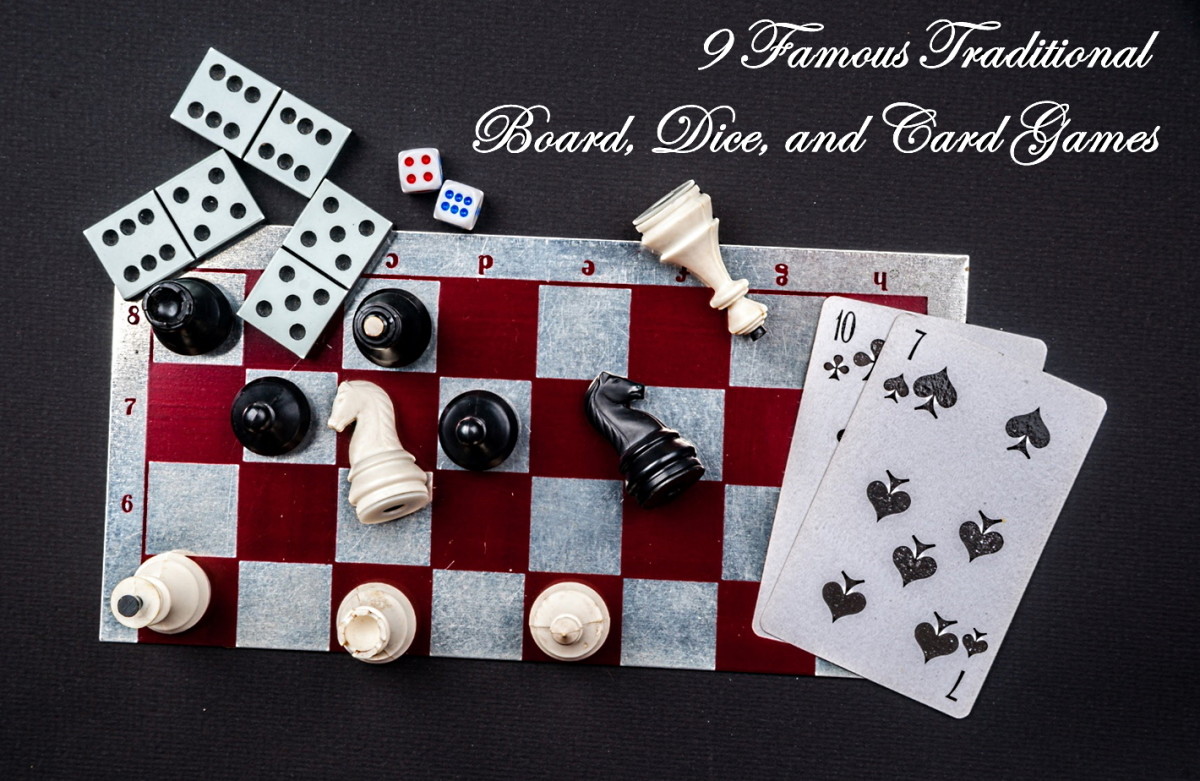
The old games are still fun despite the emergence of thousands of new-age digital games in the market. Many of us still love and play traditional board, dice, and card games. A lot of these games have been around for hundreds of years (with a couple existing way before that). Chess, an old game, is thought to be about 1,500 years old, while backgammon is a staggering 5,000-year-old game!
Ludo, dominoes, chess, cards—all these games are worth revisiting.
Electronic Games vs. Traditional Games
Do you remember how just over half a century ago we thought games like Ludo, Backgammon, cards, Snakes and Ladders, and dominoes were some of the best games ever? Some of us still think they are.
Traditional games were great for our mental health, promoted skills, encouraged us to play in groups and have fun, helped us make new friends while strengthening our bonds with old friends, and best of all, traditional games were healthy games that were relatively cheaper than today’s e-games.
Many electronic games played today mostly come with noteworthy disadvantages. For instance, it is known that e-games may hurt our visual health in the long run. Also, it is claimed that they harm our physical health. We sit playing all day, become lazy due to lack of exercise, and become fat because we munch continuously while playing.
Pre-21st Century: The Popular Classic Games
Some of the most famous and popularly played classic board, dice, and card games in the 19th and 20th centuries are:
- Ludo
- Snakes and Ladders
- Dominoes
- Mancala
- Monopoly
- Backgammon
- Scrabble
- Chess
- Cards
1. Ludo: Board, Token, and Dice Game
Ludo is a simplified version of Pachisi, a medieval cross and circle board game that originated in India. It is one of the easiest traditional board, token, and dice games to play. It is played by a minimum of two, and a maximum of four players. Players play by racing their tokens from start to finish, and their luck depends on dice rolling and strategic placement of the tokens.
Players must throw a 6 on the dice before making a first move from the home area. They then proceed from their starting square. Each player has a different colour which determines the route of movement. Players can only move one to six steps at a time.
When a player throws a 6, he or she may bring a new token onto the starting square. The player may, however, choose to move a token already in play instead.
When a player’s token falls on an opponent's piece in the course of moving on the board, the opponent's piece is captured or "pecked"! at this point, the opponent's captured token is sent back to the start position.
There is a doubling rule every Ludo player loves to get. Here, when a token of the same colour lands on another of the same colour, the doubling becomes a barricade against all other players. He or she can decide to open up this blockade when he/she pleases or when there is no other option than to move on.
On completion of a circuit of the board, a player’s token moves up the home column of its colour. The player must throw the exact number required to advance to the home square. The winner is the first player to get all four of their tokens onto the home square.
2. Snakes and Ladders: Board and Dice Game
Snakes and Ladders is an ancient game that is known to originate from India. When the game made its way into England, it was sold as "Snakes and Ladders" while the basic concept of the game was introduced into the United States and called Chutes and Ladders. This traditional board and dice game is now regarded as a worldwide classic game played mainly by children but equally enjoyed by many adults as well.
It is played between two or more players on a gameboard made up of square grids numbered from 1 to 100. On the board are illustrations of snakes and ladders with each connecting two of the square grids in no particular order. The snakes are drawn haphazardly at different positions from the ladders. The goal is to get up to the 100th square by getting around the snakes and trying to climb up the ladders to gain an advantage.
Each player must try to prevent opponents from getting to the top level first, or onto the 100th square. This can be done by using various power-ups, which can be used to an advantage, or to slow down the other players.
3. Dominoes: Board and Tile-Based Game
What we know as dominoes today is a game that first appeared in Italy around the 1700s. Before this time, it was unknown to Europe. The game is very popular in Latin America and is considered the national game of most Caribbean countries.
Domino games consist of white tiles with black dots (or black tiles with white dots) called building blocks. The game’s objective is to assemble these tiles in many ways to create a large variety of games that require great skill and strategy.
The game is played by four people divided into two teams. To play the game, the dominoes are shuffled face down with the flat of the hand. Each player gets seven tiles, and the remaining dominoes are placed in the “boneyard” to be drawn from by any player unable to play a tile from his or her hand.
The first player to go is the one holding the double-six tile. If no one has that, then it will have to be the first player with a double-five, and so on. The tile played must be the double tile that permits the player to take the first turn and if none of the players holds a double, then the tiles are reshuffled and drawn again.
Each player must conceal their tile's value from the other players.
The objective of the game is to be the first team to reach seven points. The game consists of several hands, each of which is worth one or more points, depending on the bid. After the game, the remaining dominoes are referred to as the "sleeping tiles."
4. Mancala: Board and Seed Games
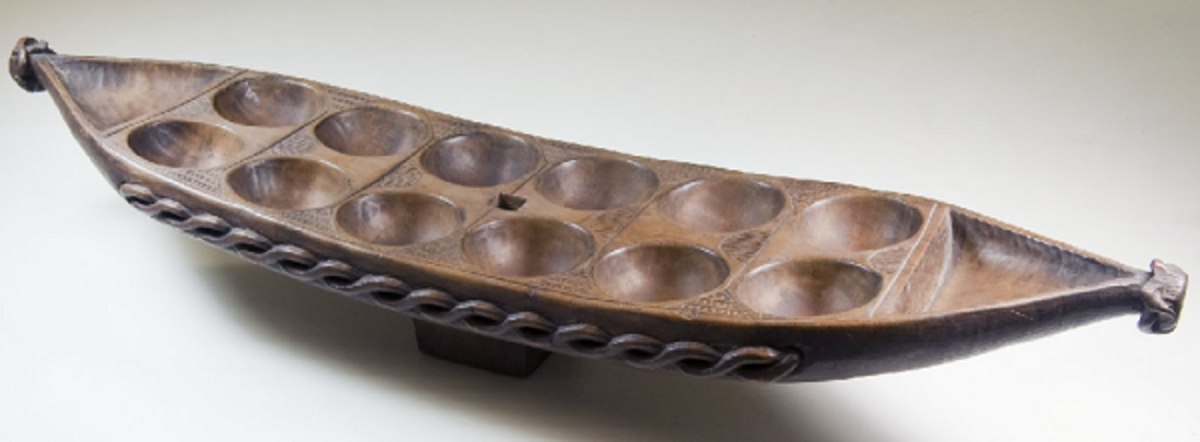
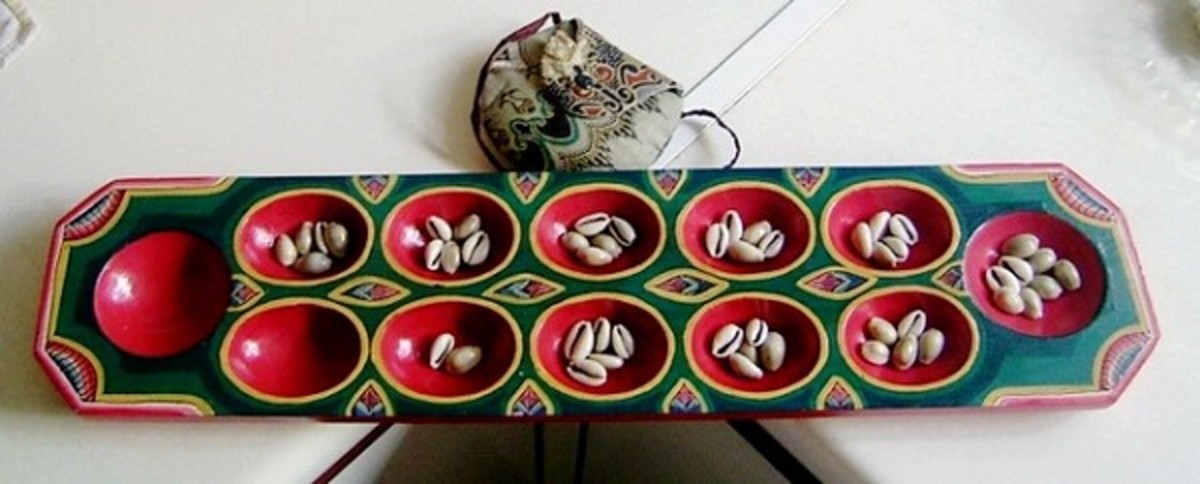
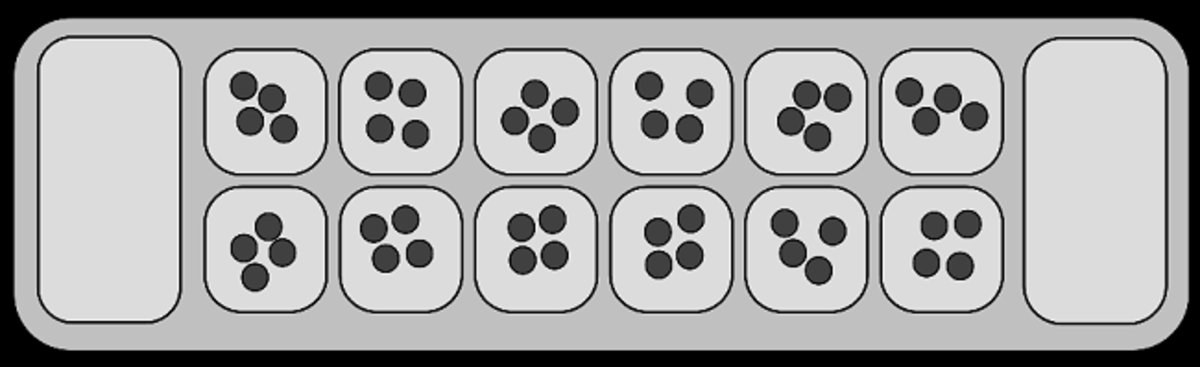
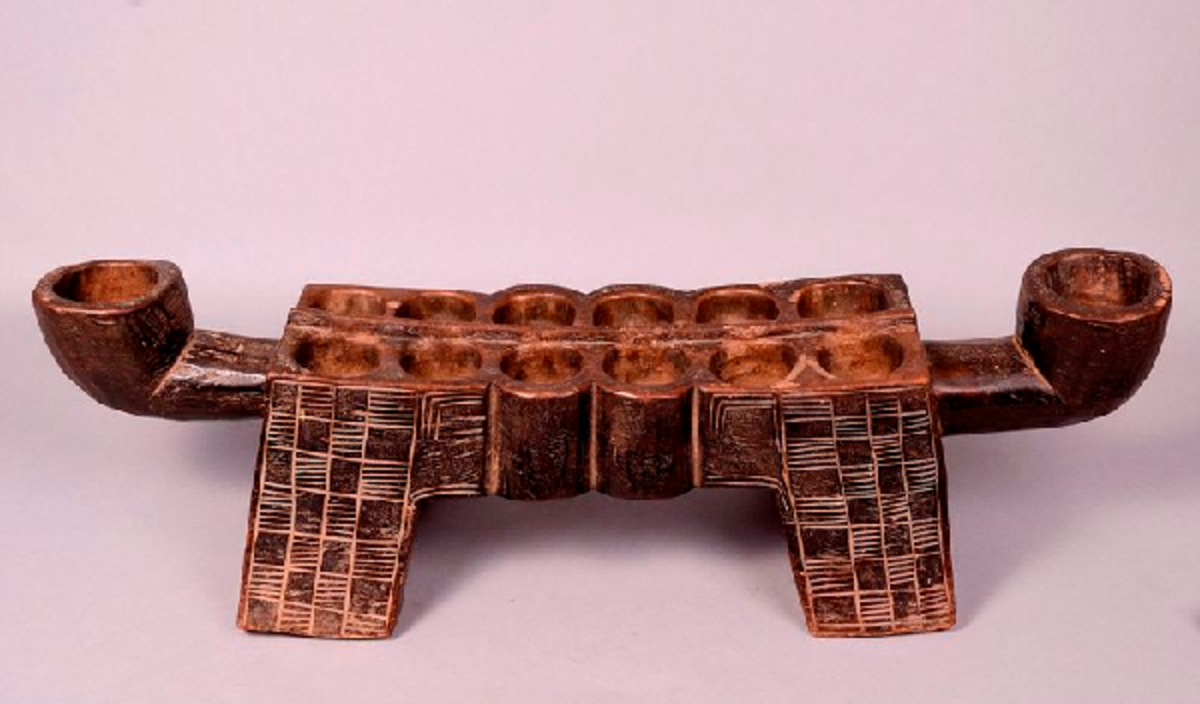
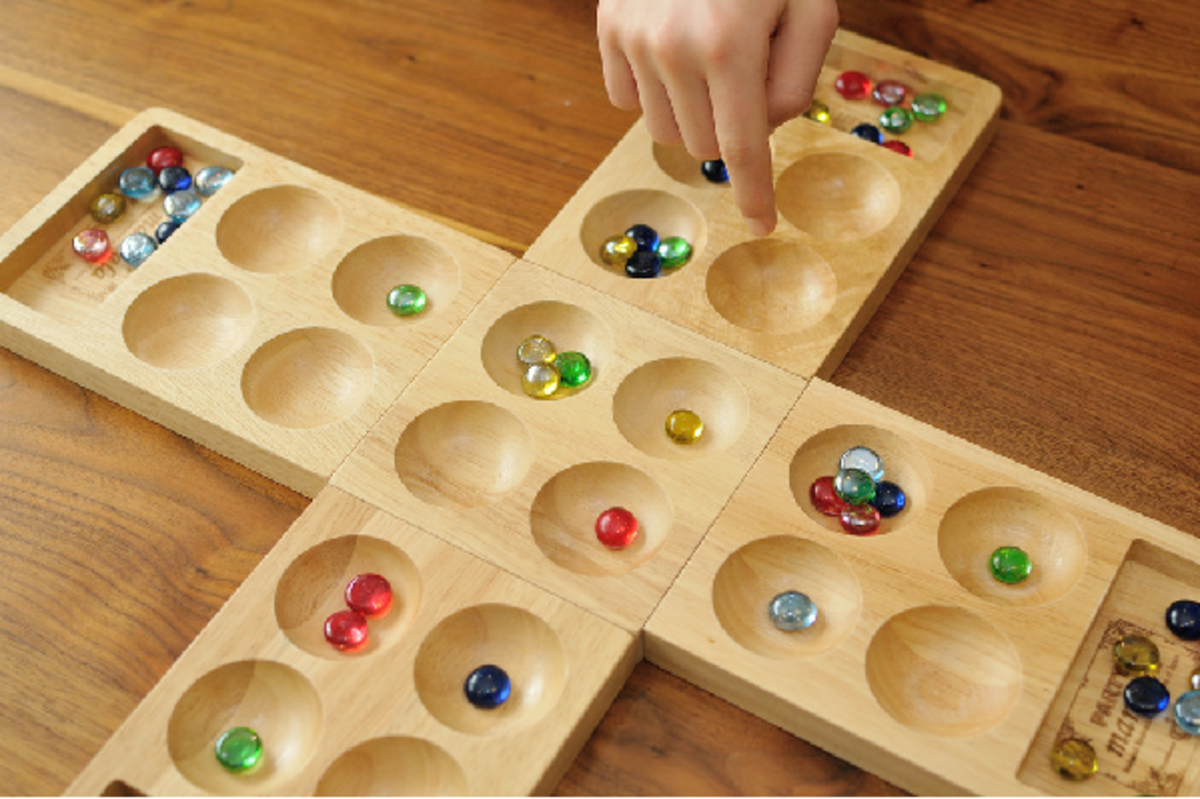
Mancala is a group of games that originated from Africa and is similar to dominoes and Card games in that it is also a group of games which fall under one heading. Also called Ayo, Oware, or Awele, this game is played on a board with carved-out holes and consists of two rows (or ranks) of twelve holes, six a side, and two store pits at each end used as a hold for the winnings.
Before the advent of carved boards, mancala games were played with holes dug in the earth or carved out of stone.
There are variations in the playing board with some having more holes on either side, or more rows to create four rank Mancala boards. Traditional mancala has 48 seeds used for the game with four in each hole at the start.
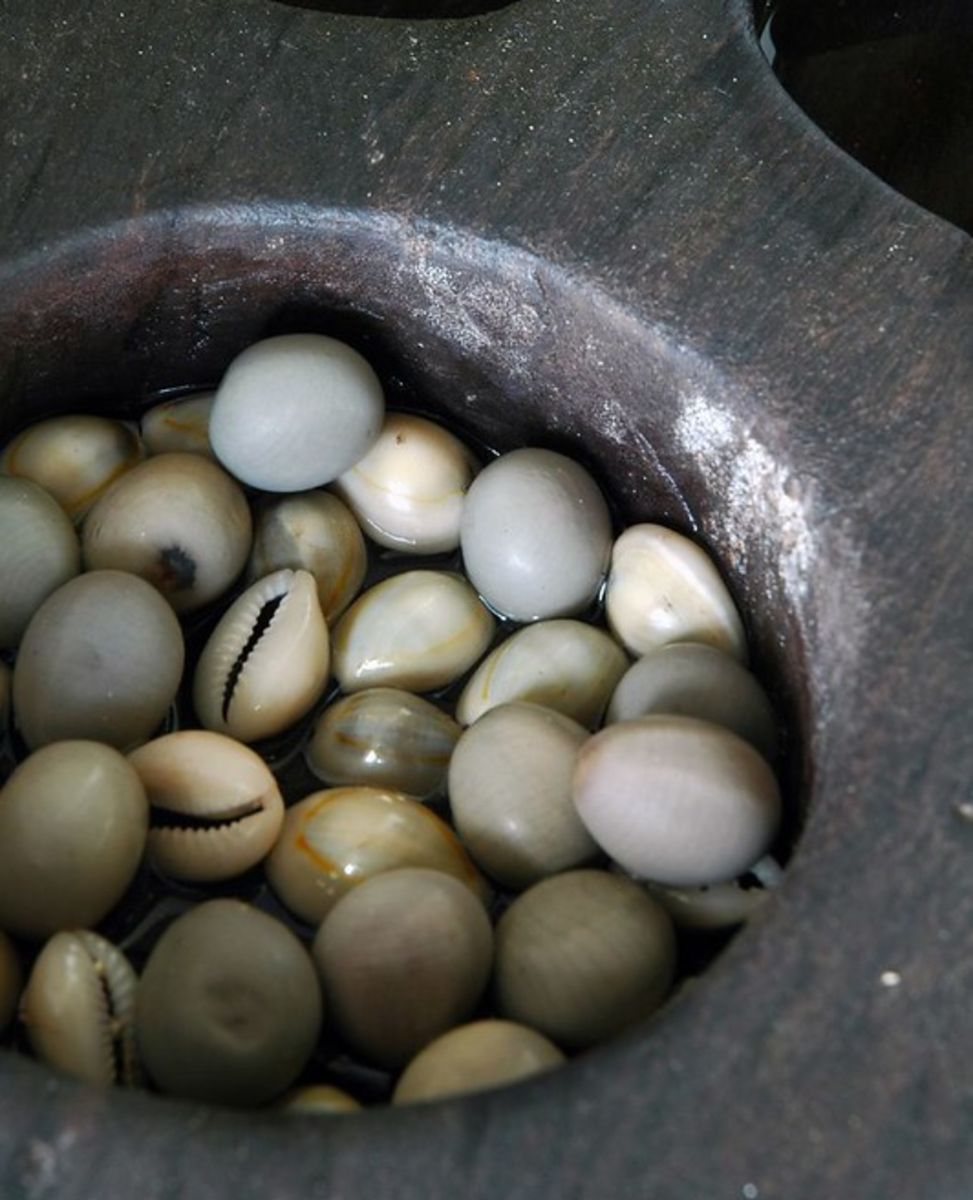
The game is played by two people. The playing pieces can be small stones, seeds, or beans which are moved from hole to hole during play. The objective is to capture more seeds than the opponent, leave the opponent with no legal move, or have your row empty first, to win.
5. Monopoly: Traditional Board and Dice Game
The Monopoly board game has its origin in America in the very early 20th century. The earlier version of the game was called The Landlord's Game and was designed by Elizabeth J Phillips, nee Magie, around 1902. It was a precursor to the game we now know as Monopoly.
Monopoly soon became immensely popular, and by the early ‘70s, the game’s first International tournament was held.
The game involves the acquiring and selling of property and the development of land and is one of the best-selling board games in the world. It is an exciting game where you have the chance to wheel and deal your way to the top, offering the thrills of getting rich and acquiring various properties along the game path.
Named after the economic concept of the domination of the market by a single entity, the game involves some aspect of luck with the rolling of the dice. There is a determining factor in throwing the dice because you may be lucky to own key properties, or you may be sent to the poor house by landing on properties with high rents.
The board consists of 40 squares, which include:
- Properties
- Streets
- Railroads
- Utilities
- Jail
- Free parking space
Players are represented by tiny metal pieces moved around the perimeter of the board. The squares you move onto depend on your throw of the dice. The metal pieces are crafted in the form of a:
- Wheelbarrow
- Battleship
- Horse and rider
- Train
- Thimble
- Cannon
- Boot
- A dog
- Top hat
- Iron
To play, each player starts with $1,500 and rolls two dice to proceed. The rest of the money and all properties are lodged in the "bank." As players move along the squares, they can buy and trade in properties and develop their real estate with houses and hotels. Money can also be gained (or lost) through Chance cards, Community Chest cards, and tax squares. If a player lands on your property, you collect rent, and if you land on his property, you pay rent.
These all lead to the main objective of the game, which is to drive your opponent into bankruptcy and attain wealth. Players can end up in jail, and to get out of jail, you must meet some conditions.
Monopoly is my favorite game next to chess. A game where buying and selling properties and getting rich is the objective can make you feel exhilarated, or at the other extreme, sad. My passion for Monopoly fuelled my interest in a career in the real estate and building industry, and prompted me further to read a book called The Monopoly Philosophy. In a way, this book taught me how to use board game strategies to find financial freedom in investment real estate.
6. Backgammon: Table and Dice Game
Backgammon is one of the oldest known board games with a history that dates back nearly 5,000 years. It is a two-player game board game with an aspect of luck but with a large scope of strategy. There are many variations of backgammon, but they all have many similarities.
To start the game, each player has fifteen checkers which move between twenty-four narrow triangles referred to as points. The triangles have alternating colours and are grouped into four quadrants of six triangles each. With each roll of the dice, a player must choose from numerous options for moving his checkers while anticipating possible countermoves by an opponent.
The objective of the game is to be the first to get your checkers off the board. Players may raise the stakes during the game, and there is an established repertoire of common tactics and occurrences. Today, backgammon has joined the class of computerized games with software that is capable of beating human players.
7. Scrabble: Board and Word Game
An American architect, Alfred Mosher Butts (1899 to 1993) invented a game called Lexico, a game that can be described as the progenitor of the Scrabble board game. He changed the name to Criss-Cross Words, but by 1938, his business partner, James Brunot, came up with the name Scrabble.
A Scrabble board is composed of 100 lettered tiles including two blank ones. It is a game of both skill and luck. It is played by 2 to 4 players who form words from tiles of individually numbered letters on a 15 x 15 grid board. The numbers range from 1 to 10 and the common letters, especially vowels, are usually worth just a few points. Less common letters such as Q, Z, and X carry higher points and give higher scores when used to form a word. The two blank tiles carry no points but can be used to substitute any letter. Once placed on the board, the letter choice remains fixed.
Within the grid are colours—red, pink, and dark and light blue. These coloured squares are premium spots where scores are multiplied and can be doubled or tripled, letters or numbers. The middle square is marked with a logo and counts as a double-word square.
Words are formed in crossword fashion across the grid and the words spelled out on the boards must be found in a standard dictionary. However, there are permissible words for the game which can be found in The Official Scrabble Players Dictionary. There is also the "Collins Scrabble Checker” which can also be used to check if a particular word is acceptable or not.
Scrabble is a very popular traditional board game among adults and children and is a game that will help any child develop their spelling skills while helping them discover new words they never heard of. Adult players can make deft spelling moves to score very high marks.
8. Chess: Board Game
Chess is one of the oldest games of skill known to man and has become the true game of the brain. Some historians date it back as early as the 2nd century, but historians believe playing a form of chess started as early as the 7th century and there is documented evidence to prove this.
Playing chess enhances your power of analytical thinking. The game is also known to boost and sharpen the intellect of young players. Chess playing can also be an immensely beneficial pastime because playing results in better brain functions, and improved memory and cognitive abilities. And because it is a game of strategy, it is great for tactical thinking and attention improvement. With chess, you will also learn the importance of planning and foresight.
A chess board and its 32 pieces are made from many diverse materials that range from exotic woods to granite, marble, plastic, and even, tempered glass. Classic and modern chess pieces make some of the most exquisite works of art.
Chess is played by two people. The board's grid is divided into 64 squares, arranged in an 8 by 8 fashion. There are 32 chess pieces; 16 white for one player and 16 black for the other. The pieces are arranged on the two ends of the chess board and consist of 1 King, 1 Queen, 2 Rooks, 2 Bishops, 2 Knights, and 8 pawns. Each of these pieces has its own unique pattern of movement.
The King can only move 1 square at a time, in any direction.
The Queen can move both diagonally and in a straight line.
The Knights can only move in an L-shaped pattern.
The Bishops can only move diagonally.
The Rook can only move in a straight line.
The pawn can move in a straight line, one square at a time. However, it can only capture a piece diagonally forward.
The main objective of the game is to checkmate your opponent's King when it is under a direct attack with no way to allow it any further move. At the point when a King cannot avoid capture, it is checkmated. That means the game is over. When a chess game is a draw, it means that a player has no legal move, though his king may not be in check. In this instance, the game is said to end in stalemate.
Chess has come a long way since 1945 when Alan Turing used chess playing as an example of what a computer could do. In 1950, the first chess computers were born, and today, the most popular chess games are either played individually against a hand-held chess computer, or played online, either against a computer or across the internet with unknown opponents.
9. Card Games
Cards playing is believed to have originated in China during the Tang dynasty around the 9th century AD. Historians have suggested that cards were first introduced as a form of "play money" that represented the stakes for other gambling games.
There are five suits in a pack of cards made up of:
- Hearts (red)
- Clubs (green)
- Spades (black)
- Diamonds (yellow)
- Stars (blue)
Each of the five suits has 16 cards:
- 1 to 10
- King
- Queen
- Jack
- Princess
- Ace (distinct from 1)
- Joker
With cards, countless games exist. While some games have formally standardized rules, others can vary by region and culture.
Before a card game begins, one of the players (dealer) shuffles the cards to put them in random order. While shuffling the cards, the dealer holds the cards in a way that he/she and the other players cannot see any of the card faces.
To start, the dealer distributes cards to each player in a clockwise manner, one piece at a time, an act referred to as dealing. Note that distribution could be clockwise or anti-clockwise, depending on which part of the world you come from.
A game can be played alone (lone player) or with a group of people. An example of a one-player card game is Solitaire. Most Solitaire games begin with a specific layout of cards, called a tableau, and the object is to either construct an elaborate layout or clear the tableau and the draw pile (or stock) by moving all cards to one or more "discard" or "foundation" piles.
Some card games revolve around the waging of money and are played mainly in casinos, or at gambling games. Poker is an example of a game where players bet against each other. Others like Blackjack have players playing and betting against the house. Poker is one of the most universally known card-playing games in existence.
There are also trick-taking games that are based on playing multiple rounds (or tricks) where each player plays a single card from their hand. Based on certain values, one player wins or "takes" the trick. The specific object varies with each game and can include taking as many tricks as possible, taking as many scoring cards within the tricks won as possible, taking as few tricks as possible, or taking an exact number of tricks. Bridge, Tarot card games, Spades, and Hearts are popular examples of trick-taking card games.
Winning a card game primarily rests on "mother luck."
(Article originally published by the author at hubpages.com on 06/20/09)
Related article
Sudoku for Senior Citizens: Benefits of Playing Number Games