The Water-Hydration Rule That Was Never Real

For over 80 years, you’ve been lied to about drinking water, and it all started in 1945.

You have probably been told, at some point in your life, to drink eight glasses of water a day. Your doctor may have mentioned how important it is, and your fitness app almost certainly tracks it. This myth has been repeated often and so confidently that questioning it feels like questioning the law of gravity!

But you know what nobody tells you? That rule has never been supported; not by a single scientific study anyway.

A glass of water. How many glasses do we really need each day?


Researchers at Dartmouth’s Geisel School of Medicine traced the claim back to its origin and found something remarkable. The “eight glasses daily” idea was never a medical recommendation at all. It was a single mis-read sentence from a 1945 nutrition guide, taken out of context, repeated across decades until it finally became an erroneous fact.

The sentence, for what it’s worth, noted that most of the fluid we take is already contained in the food we eat.

That part never made the headlines.

How Misreading Can Start a Movement


The eight-glasses rule didn’t survive almost a century because it was true, but also because it was useful, particularly for the bottled water industry, which grew dramatically alongside the idea that the average person is “one glass short” of healthy.

McGill University’s Office for Science and Society identified this as a nutritional myth that has been kept alive, not by evidence, but by commercial interest and cultural repetition. None of which means hydration doesn’t matter.

Of course, hydrating adequately matters, but there is a difference between us staying well-hydrated and chasing some daily number that was never scientifically established in the first place.

What Our Body Is Actually Doing


The human body has a remarkably precise thirst mechanism. When our fluid levels drop, even slightly, our brain registers the change and generates a thirst signal. This is not a warning that something has gone wrong, but rather that our system is working exactly as it should.
Feeling thirsty is our body doing its job.

This means that for most healthy adults, drinking water only when thirsty is a perfectly adequate hydration strategy. We don’t need to pre-empt thirst or track the amount of water we take to stay on top of it.

Drinking Enough Water or Not. The Powerful, Practical Check


A more practical and reliable check of whether we are drinking adequate water each day is in the colour of our urine.
  • Pale yellow indicates good hydration.
  • Dark amber is a signal to drink more.
  • Completely clear urine may actually mean you have been drinking more than your body needs.
Simple. You don’t need costly medical examinations to know.

What We Eat Counts Too


Surprised? Well, if you must know, a significant portion of our daily fluid intake comes not only from drinks, but from food as well, particularly the fruits and vegetables we eat, many of which are largely composed of water. For instance, cucumber, watermelon, oranges, celery, tomatoes, and leafy greens all contribute meaningfully to hydration.

If you eat a plant-rich diet and drink when you are thirsty, you are very likely to meet your body’s water needs without counting in glasses.

This is the missed-out part of what the original 1945 text was saying. The piece that got lost in translation for the better part of a century.

When Individual Needs Vary


Our hydration requirements are not a one-size-fits-all thing. It is important to note this. Look at it this way:
  • Hot weather
  • Physical activity
  • Illness
  • Pregnancy
  • Breastfeeding
  • Certain medications
These and other factors can all increase how much fluid our body requires.

Older adults, unlike younger ones, may have a less sensitive thirst response and benefit from drinking more consistently throughout the day, rather than waiting for strong thirst signals that may not be apparent.

The main point is not that hydration is unimportant but that our actual needs depend on our actual body and our actual circumstances. Not on a number someone else invented (perhaps intentionally) from a misread page.

A Simpler Way to Think About Drinking Water


Letting go of the hard-to-keep 8-glasses-of-water rule is not an excuse to ignore our bodies. It is the opposite. It is an invitation to pay closer attention to hydration. Drink when we are thirsty. Check our urine colour as a simple daily cue. Eat plenty of water-rich foods. Adjust when life calls for it.

That is not a shortcut. That is just listening to our bodies, which, as it turns out, is something it has been trying to help us do all along.


*Disclaimer: This article is for general information purposes only. It is not a substitute for professional medical advice because individual hydration needs vary. If you have a health condition, are pregnant, take regular medication, or have any concerns about your fluid intake, please speak with your doctor or a qualified healthcare professional before making changes.

9 Healthy Benefits of Indoor Water Features

If you have ever stood beside a flowing stream or listened to rain falling softly on leaves, you will notice that moving water makes you feel good and relaxed. Indoor water features also bring that same feeling into your home. A feeling of calm and serenity. Whether you choose a sleek wall-mounted fountain or a compact tabletop feature, these flowing water features offer far more than visual appeal. They create an atmosphere that nurtures your health, lifts your mood, and transforms the way your home feels, to live in.


The following are nine reasons why you should invest in a water feature in your home. It doesn’t have to be anything pricey if you have a lean purse. However, the benefits gained from just one water feature far outweigh what money can buy. 

1. Calming and Soothing


The sound of flowing water has a remarkable way of quieting a busy or troubled mind. It draws attention gently away from anxious thoughts and toward something steady and pleasant, much like listening to a distant mountain waterfall from the comfort of your own living room. Many homeowners have described a genuine sense of tranquillity and serenity that settles over a room once a water fountain is running. At night, that soft, rhythmic sound is natural white noise that helps slow down your thoughts and lull you into a deep, restful sleep.

2. Production of Beneficial Negative Ions


Flowing and softly falling water naturally generates negative ions. These minuscule electrically charged particles occur abundantly in nature near waterfalls, oceans, and after rainfall. Research has suggested that negative ions may increase serotonin levels, help to lift mood, and relieve stress while keeping the mind alert and focused. Bringing a water feature into your home allows you to benefit from this effect daily, in your own space, without needing to step outside.

3. Natural Humidifying


Indoor air, especially in heated or air-conditioned rooms, can become very dry and uncomfortable. An indoor water feature will gently release moisture into the air, naturally raising the humidity of the room. This added moisture will increase the elasticity of your respiratory passages, making breathing easier and reducing the irritation that dry air causes. It is particularly beneficial during winter months when central heating strips the indoor air of moisture.

4. Skin Therapy


The same humidifying effect that’s good for your respiratory system is also great for your skin. A more moisture-rich space helps keep skin hydrated and supple, which is especially valuable for people who have dry or sensitive skin. Over time, the improved air quality can help reduce skin rashes, flakiness, and skin irritation triggered by dry or pollutant-heavy air. The humidifying effect acts as a quiet, ongoing form of skin care within your home environment.

5. Relieves Stress


Coming home after a long, demanding day to the sound of quietly flowing water has a measurably different effect on the nervous system than walking into silence or background noise. The combination of gentle sound and the visual rhythm of moving water works to calm the body’s stressed-up feeling, releasing tension from muscles and settling an overactive mind. Interior designers and wellness specialists increasingly recommend indoor water features as a practical tool for creating genuinely restorative home environments.

6. Promotes Healing


Indoor fountains have been recommended by therapists as a supportive tool in treating conditions such as PTSD and chronic insomnia. The consistent, non-intrusive sound of water is wonderful for meditation and mindfulness practice, both of which have well-documented benefits for physical and emotional recovery. For anyone going through ill health or emotional difficulty, the sound and presence of flowing water can make the home feel more like a healing space.

7. Stimulates Happiness


There is a reason why some people love to travel to be near the sea, rivers, and waterfalls. 
  • Moving water is invigorating. 
  • The sight and sound of falling water trigger positive emotional responses, lifting mood and creating a sense of energy and vitality. 
Having that stimulus present in your environment means those mood-enhancing effects become part of your ordinary routine rather than something reserved for the holidays.

8. Increased Sense of Security and Well-being


Research into the psychological effects of water in interior spaces has consistently shown that its presence contributes to a greater sense of overall well-being and security. Water is one of the two foundational elements in Feng Shui, the ancient art of arranging interior spaces to encourage balance, peace, and harmony. When you incorporate flowing water into your home, it connects with something deep and instinctive in us. A sense that the environment is alive, balanced, and nurturing.

9. Longevity


The cumulative effect of reduced stress, better sleep, improved air quality, and a calmer emotional state all provide the same outcome: a healthier, longer life. While there is no single thing that promises longevity, the daily benefits of living with flowing water features contribute to the kind of balanced, low-stress lifestyle that supports long-term health and vitality.

Maintaining Your Indoor Water Feature


One of the practical advantages of modern indoor water features is how easy they are to clean and maintain. Most of them come with a self-contained plumbing system, so no specialist installation is required beyond positioning and plugging in.

For day-to-day care, you will need to: 
  • Top up the reservoir regularly with a few cups of water per week, depending on the size of your feature and the humidity of your room.
  • Give it a thorough clean every two to four weeks. This keeps the fountain looking its best and prevents the build-up of algae, limescale, and mineral deposits. All you need is a soft brush, a mild cleaning solution, and a good rinse of the pump filter.
Water feature pumps are designed to be durable and long-lasting. Most models allow you to adjust the flow rate, so you can dial up a livelier cascade or slow things down to a gentle trickle, depending on your mood and the atmosphere you wish to create. Checking the pump periodically for debris and descaling it every few months will keep it running smoothly for years.

Bringing It All Together


An indoor water feature is one of those rare additions to a home that earns its place on every level simultaneously: aesthetically, practically, and for your health. Whether you are drawn to the clean lines of a contemporary wall fountain, the organic feel of a stacked stone waterfall, or the understated charm of a tabletop feature on a sideboard, the benefits remain consistent. Start with a style that feels right for your space, and let the water do the rest.

Miniature Collectables: Fully Furnished Mini Homes


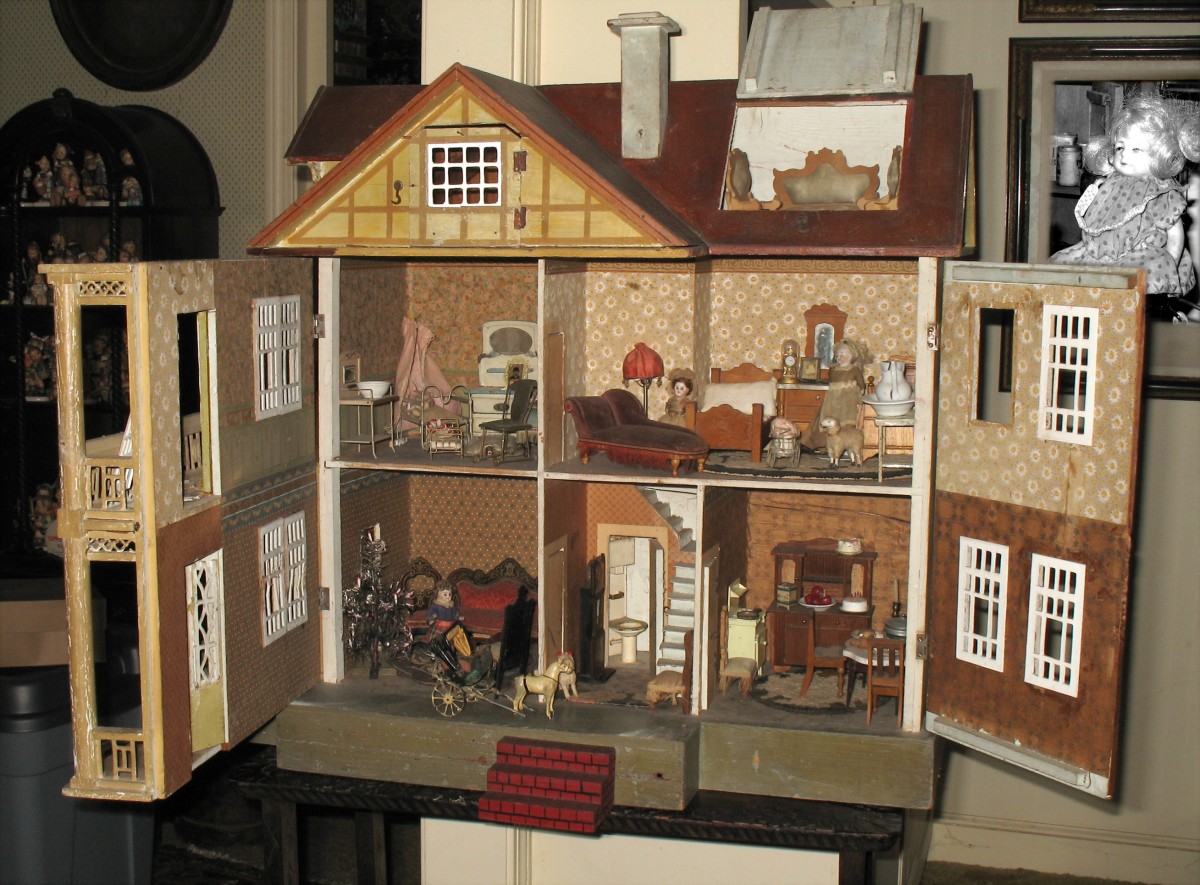
Antique English Dollhouse

What Miniature Dollhouses Represent


Barbie dollhouses may be the modern version of classic miniature homes, but, traditionally, handcrafted miniatures were not toys that children played with. Miniature homes represented many things to different people. They were: 
  • Moral instruction ‘tools’ for young girls. Dollhouses were used to teach girls domestic and home improvement skills—the things required of them when they got married and had to run their own homes. The handcrafted home interiors had all the imaginable household items needed, like porcelain, napkins, sweepers and dusters, pots and pans, and even things as simple as tea cosies.
  • Priceless collectables. Many upscale dollhouses were owned by wealthy adults who loved, genuinely appreciated, and collected these beautiful, intricate museum-worthy works of art for their own pleasure.
  • Entertainment and conversational pieces. Nobles displayed miniature houses to delight their guests and show off their superb taste in art.
  • Investment opportunities. Some owners amassed their miniature collections, knowing they would eventually become antique keepsakes of extremely high value.
  • Structures of personal fascination. Dollhouses provided an eye into a miniature world of unimaginable and luxurious living. It is so inexplicably satisfying to see familiar things in miniature forms, scales, and sizes.
  • Opportunities for voyeurism. These mini-worlds offered a sense of playing god, with the viewer being the ruler of a tiny yet distinct world filled with little people and things.

In a world where most millennials cannot even think of purchasing real property, it is no real wonder that dollhouses remain, for many of us, a gentle bit of wish fulfilment.

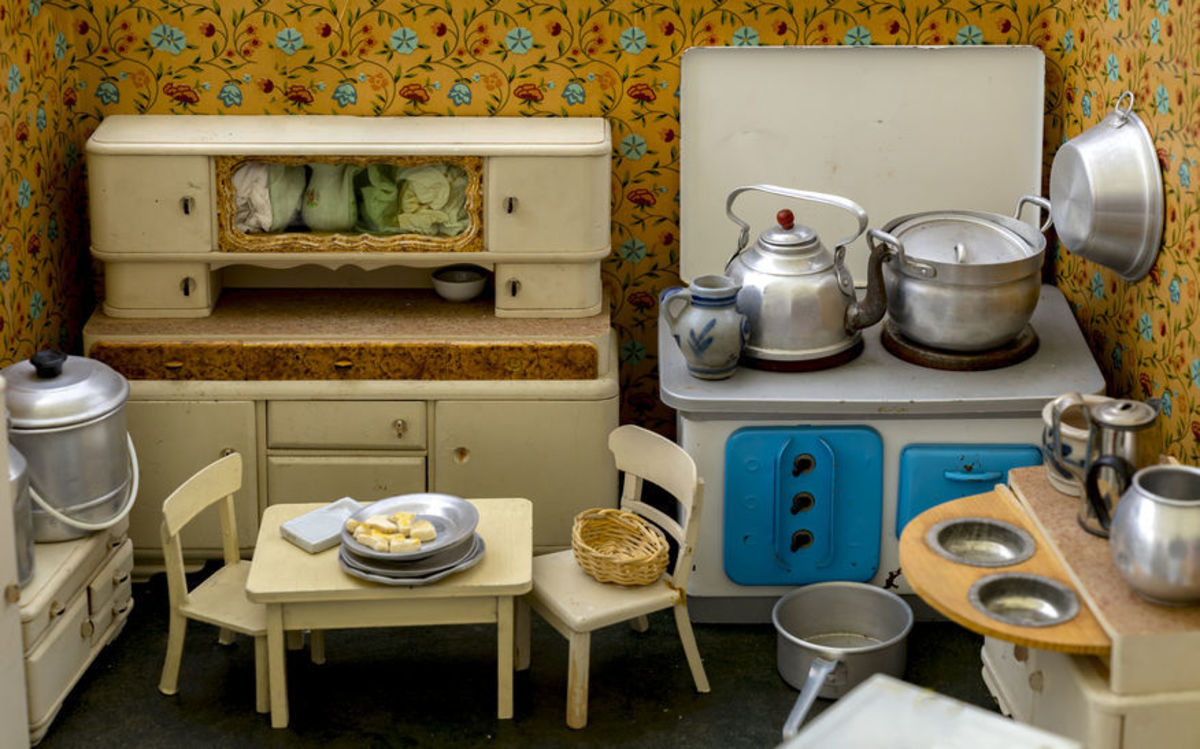
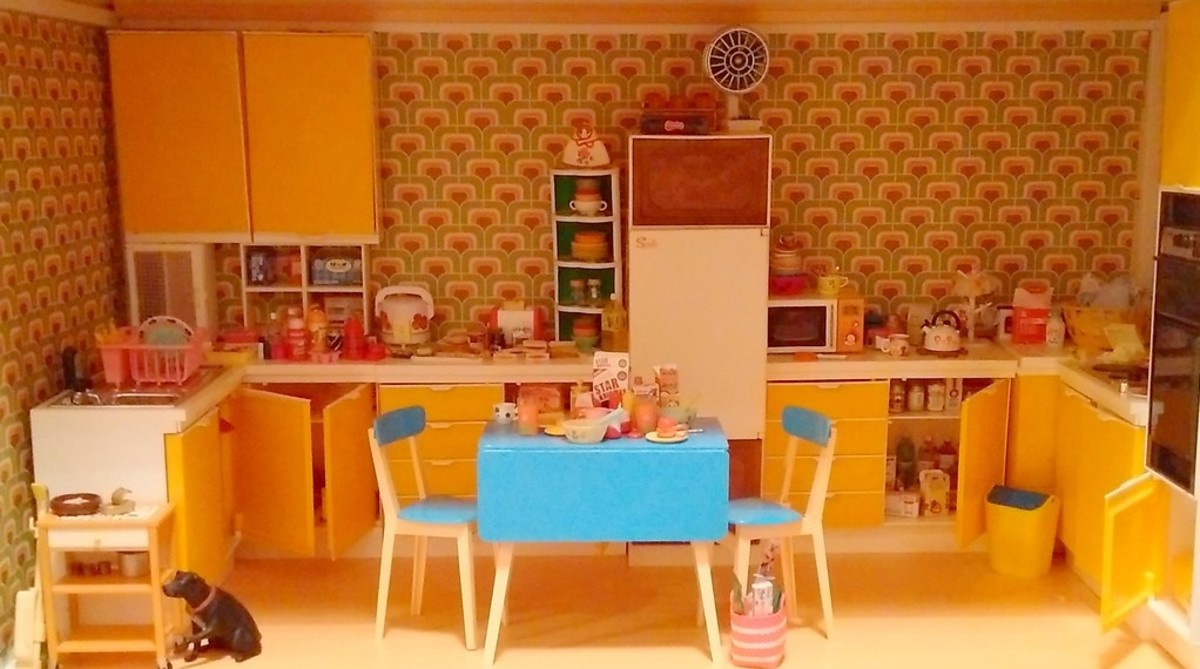
Vintage miniature home kitchen with everything a young girl needs to practice cooking, cleaning, and organising. 


Classic Miniature Home Styles


To enthusiasts and collectors, having a choice of architectural styles is part of the essence of collecting miniature homes. While some collectors only go for closed-crafted miniature houses without a view of the inside, others prefer homes with viewable rooms, where each room is intricately designed with furnishings of different periods. Every detail of the interior is included in the structure, including wallpaper, floor coverings, and tiny light fittings.

Some popular architectural and interior design styles for miniature houses include:
  • Colonial
  • Victorian
  • Art deco
  • Edwardian
  • Mid-century
  • A-frames and cabins

Closed vs. Open Dollhouses


A closed-crafted home only provides an external view. You can't see into any of the rooms. An open home will have viewable rooms.


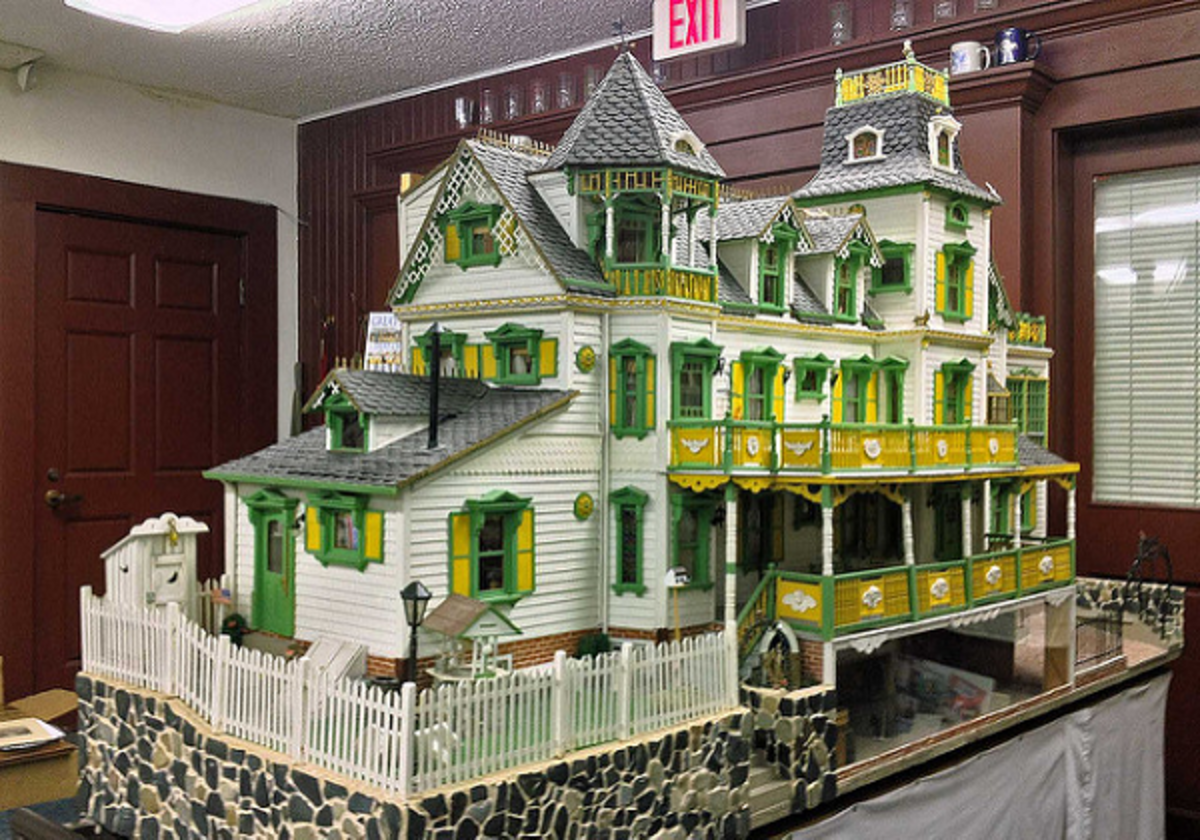
A collector's item: a Victorian-style miniature house with details typical of the 19th-century homes of the wealthy.

Famous Miniature Houses


  • Some notable and priceless miniature houses include:
  • Stettheimer Dollhouse, constructed between 1916 and 1935
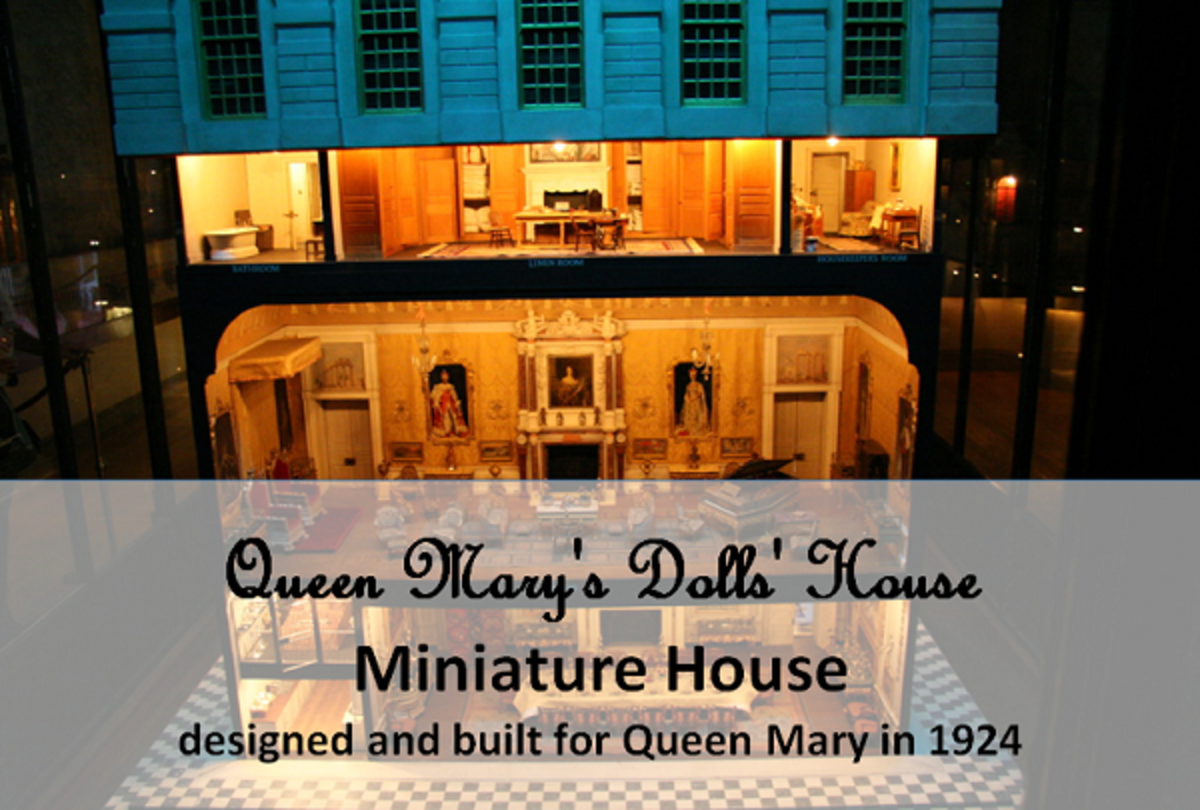
  • Queen Mary's Dolls' House, designed for Queen Mary in 1924
  • Titania's Palace, hand-built by Irish cabinet-makers
  • Tara's Palace, which took ten years to build and consists of 22 rooms

These breathtaking works of handcrafted art are cherished collectors’ items that date back hundreds of years. Today’s enthusiasts and crafters who have invested in these types of collectables can successfully sell these mementoes for great sums of money.

There are dozens of annual miniature trade shows organised by miniature collectables organisations. At these shows, craftspersons, dealers, and collectors display and sell miniatures worthy of becoming priceless and treasured heirlooms.


Mini Furniture and Furnishings


In my opinion, the most attractive miniature homes are the ones that come complete with everything that is required in a household, with or without tiny people. Everything from furniture, furnishings, appliances, fixtures, and vanities to plush sofas and accent chairs must be included in the interior rooms.

Additionally, these houses feature items like chandeliers, refrigerators, kitchen sinks, bathtubs, towels, toilet roll holders, and even bowls of fruit. Many of these elements are even more intricately crafted than the house structure itself.

Furniture Styles


As the types and styles of the dollhouses vary, so do their furniture styles. The entire interior decoration is determined by the building occupants' social stratum, and the pieces are based on their lifestyles: rich and luxurious, middle-class and comfortable, or poor and threadbare.

For instance, a miniature farmhouse will have the barest essentials of country furniture and furnishings, while a sleek modern house may feature streamlined sofas, Le Corbusier chairs, wood panelling, leather loungers, glass tables, wool rugs, and ’expensive’ wall art.

Standalone Furniture Pieces

Some miniature furnishings collectors only collect individual furniture pieces. They use these beautifully crafted pieces to create living areas, dining rooms, bedroom settings, etc. (contemporary or traditional), which they display on coffee tables, wall shelves, and special display stands and units.

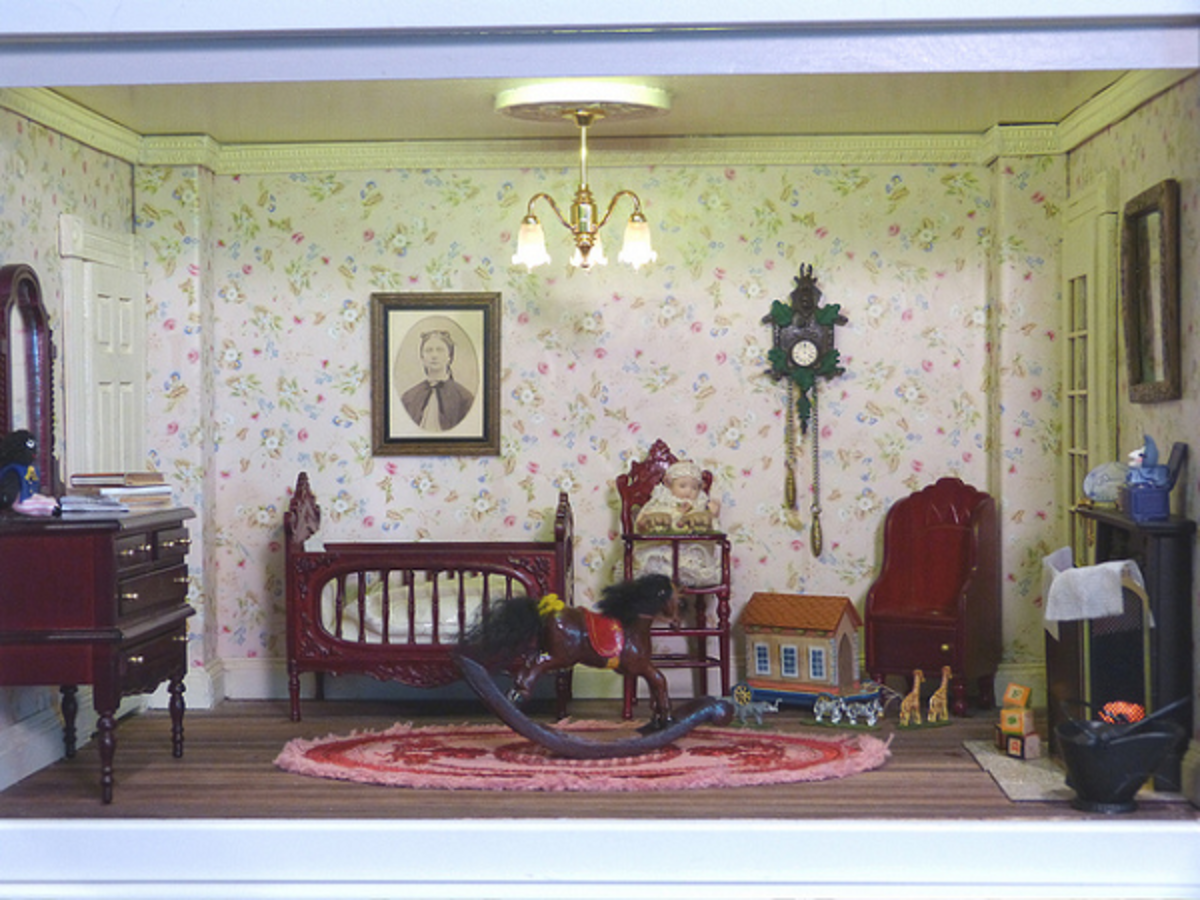
A miniature Victorian-style nursery interior. Notice the furniture, a little baby sitting on a high chair, a crib, and a rocking horse. 


Miniature House or Standalone Rooms?


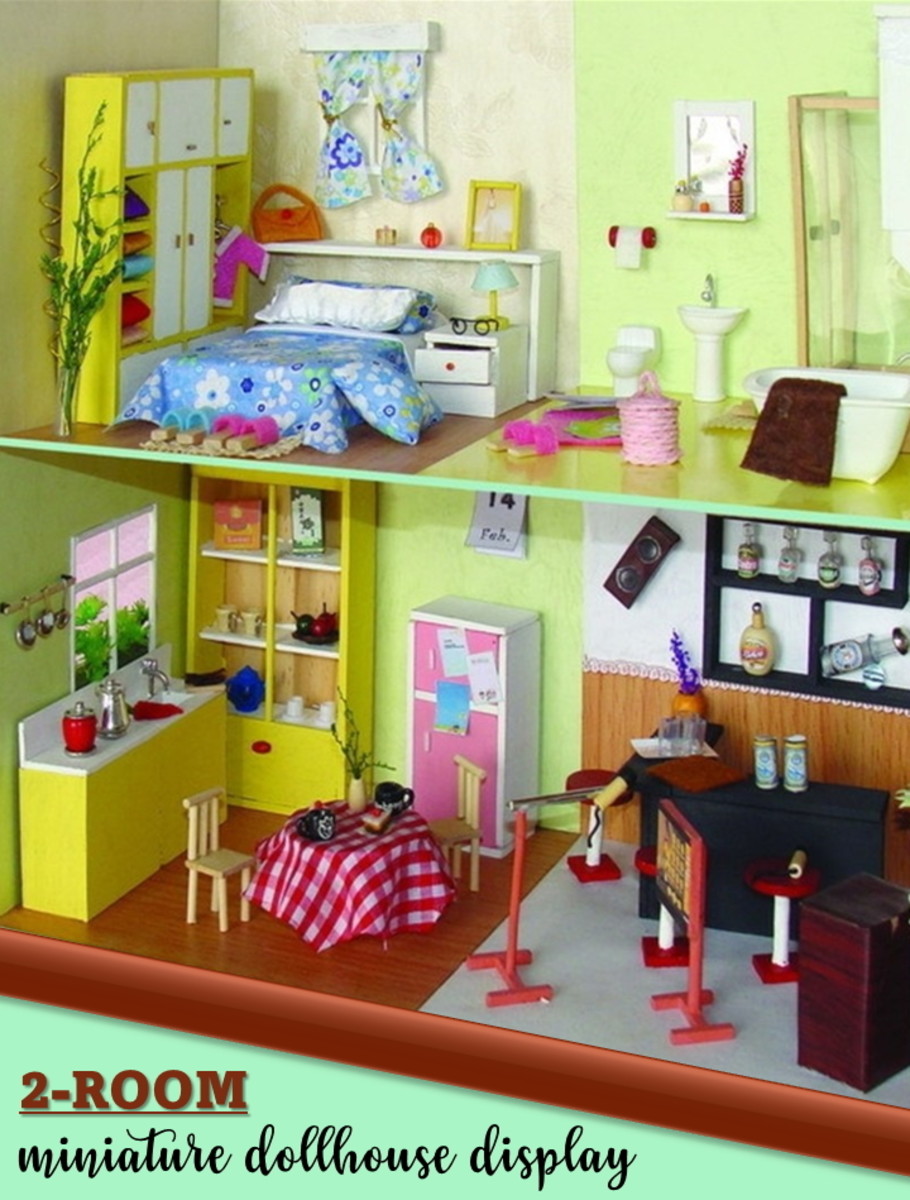
Not all miniature home collections come as complete residential building structures that comprise external walls, windows, doors, and interior and outdoor rooms. They can also come as single standalone rooms, two-room designs, and storey buildings enclosed with three walls and an exposed front opening to view the interior.

While standalone rooms are easier to build, take less time to craft, and are generally less expensive to make (depending on how simple or complex it is), a miniature house can take many months or even years to build, and it, therefore, comes with an expensive price tag.


Standalone miniature room: a fully furnished kitchen with mini elements and features.


Modern Dollhouses


Not many modern-day hobbyists like the old ornate classics like the Edwardian, Victorian, and Tudor styles. Many fans will rather opt for modern architectural and interior styles because of their clean lines and sleek minimalist interiors.

Why People Love to Collect Miniatures


Miniatures are intriguing objects; they're beautiful works of art that always tell a unique story. Museums and other exhibitors of miniature objects attest to the fact that these collections are extremely popular among visitors. It is amazing how spellbound viewers appear on seeing this category of miniature art, from the Gothic theme to the Victorian, from the first settlers’ cabin to contemporary models.

If you are a collector or die-hard enthusiast, you will agree that making miniatures is a painstaking hobby that requires creativity, patience, perseverance, and a deft and nimble touch. If you love and admire them, it is because you are in awe of how anyone can craft such minuscule objects and tiny parts.

And because the craft involves making exact prototypes of buildings, humans, interiors, furniture, and furnishings, the craftsman’s pieces must be detailed and crafted to the right scale. They must look realistic enough to be enchanting, captivating, and delightful.


Tips for Beginner Crafters and Collectors


If you want to start collecting miniature dollhouses, you can have them custom-made to your specifications, or you can purchase them from toy shops or speciality stores for miniature collectables online. You will also find them at internet auction sites and online retailers.

To build or gradually collect the pieces for a fully furnished dollhouse, here are some pieces of advice:

  • Start by building a simple, standalone room and furnish it in a way that tells a story.
  • For a traditional style, go for the impressive classics like a Victorian parlour or a farmhouse kitchen.
  • Make your house look live-in by adding occupants (miniature dolls) that will fit in perfectly with your theme. Dress them up appropriately and place them in the room. For instance, add a parlour maid serving tea to the lady of the house.
  • Ensure that your structure is as detailed as possible. Everything within it must have the right scale and proportions.
  • Display your home with ample space around it, preferably in an area set away from the walls. This is to ensure that observers will have a good view of the house from all sides.
  • For individual standalone rooms, a smaller display area will suffice. The structure can be set against a wall or on a shelf as it only needs to be viewed from the front.

A two-room miniature house with simple furniture and furnishings. A beginner miniatures crafter can start off with projects as simple as a 1 or 2-room space to gain the required skills.


Start Simple


Crafting miniature pieces is not easy. It is a craft that will test your patience, so if you do not wish to encumber yourself with an overly challenging task, start simple.

You do not have to be a skilled craftsman, though. There are miniature home kits that you can purchase if you are not a collector but wish to build. Also, an increasing number of miniature manufacturers are producing tiny dollhouses, furniture, and furnishings for people who wish to create fantasy homes.


(Article originally published by the author on hubpages.com on 02/24/10)


Articles of Interest

Raising a Kidpreneur: 9 Tips to Help Your Child Start a Business

Today’s kids are smart, informed, and curious, much more than children of the past century. With the advent of the internet and digital technology, the possibilities are endless for many children. How about you be the parent who encourages their kid(s) to become young entrepreneurs?


A young kidpreneur calculating his earnings. (Image used under license from iStockPhoto)


Yes, young. You can guide them onto this path from the age of ten, or even younger. Do not underestimate the mindset of today’s children. They are much more knowledgeable than we adults give them credit for. Never forget this fact.

Inspiration That Shows It’s Possible


Give them a gentle push, or a shove, if you have to. Ask questions about what they love to do, make, or write about. Ask in any way you feel will make them open up, think deeply about their answers, and take each answer as a clue. You never know, you may be bringing out latent talent, creativity, or even entrepreneurial skills they didn’t realise they have.

Tips for Parents: Help Your Kid Gain Financial Independence 


Earning money on the internet has become so widespread that some smart kids have hopped on the earn-money-online train, making extra pocket money.

While some earning opportunities are not age-specific, others are, but the good news is that there are jobs even if you are under sixteen. For this group of kids, parental consent and supervision is crucial. Most jobs suitable for the 10 to 15 age groups are offline, informal jobs and spare-time tasks, but there are a few that they can do online. They include (in no particular order):

  1. Garage sales. Gather together and sell old toys, books, devices, old clothes, shoes, bags (in good condition), and other no-longer-useful odds and ends.
  2. Teach the elderly simple ways to use their electronic devices. Many baby boomers don’t have a clue as to how to perform simple tasks on their devices. Young kids can teach them how to, for a fee.
  3. Pet sitting. A bit like being a babysitter, but only for young kids who love and have a close affinity with dogs. They can help walk dogs, provide companionship, or care for them when their owners are away.
  4. Gardening. Young children can earn money as a gardener’s assistant. Help with gardening for neighbours by simple planting, pruning, and trimming of plants, for a fee.
  5. Sell candy and sweet edibles. This is, without a doubt, a great way to imbibe selling skills. Loan your kid a start-off capital. $25 to $50 is good capital to invest in your child. They can sell at school during playtime. Let them find out what classmates love to snack on, then order them cheap from places like Dollar Stores, Candy Warehouse, and Walmart (on bargain days). Alternatively, making and selling homemade candy can be a fun and cost-effective alternative if your kid is so inclined.
  6. Make and sell handmade crafts. If your kid loves making small crafts, they can make simple craft items to sell at local markets or on online platforms like Etsy. However, you must help your child promote their crafts through social media or word of mouth and don’t forget to teach them how.
  7. Teach younger kids. Children who excel in a particular class subject can teach younger kids for a fee. This will also reinforce their knowledge of the subject while helping the younger ones.
  8. Start a YouTube Channel as a kid influencer. If your kids are over 13 years old, they can operate a YouTube channel (the age limit to own one is 13 and above). However, parental or guardian permission is required before starting the channel. There are many popular kid influencers on YouTube, and there is fairly good money to be made by influencers. Find out what some of these kid influencers make on YouTube.
  9. Sell T-shirts, hoodies, and sweatshirts online. This is a great online money-making venture for older teenagers. They create illustrations, design and upload, and sell them online. Sites like Spreadshirt, Zazzle, and Printify provide such services. It is much easier than it sounds. However, with the right strategy, it can be quite profitable.

Earning extra cash by themselves will serve as a foundation for a future where they will have acquired the ability to handle financial challenges on their own.

Fostering a Lifelong Entrepreneurial Mindset


Parental supervision is key. Allowing kids under sixteen to earn money online and offline is a great idea, but it requires adult supervision. Offline jobs need to be overseen and monitored. And for online jobs, because the internet is a global community, you don’t want your kid wandering around aimlessly in the community without guidance, just as in any community.

Additionally, check periodically to ensure they are not using illegal means to earn extra pocket money. And check that they don’t get so obsessed with earning money, they neglect their studies.


(Originally published by at Medium.com by Alo Bedas on 10/3/2024)


Other articles of interest.
Kids Are Making Money Online Testing New Video Games

Ginny’s Blog Corner: A Creative Space for All Ages

Some blogs are about a single topic, but this one is about a single purpose: creating space for connection, creativity, and growth at every stage of life.

Whether you are a parent looking for something to do with your children on a rainy afternoon, a grandparent rediscovering the games of your youth, a senior thinking more carefully about health and finances, a young person testing an entrepreneurial idea, or someone quietly working through a chapter of life you have not yet told anyone, there is something here for everyone.


Ginny’s Blog Corner covers five broad areas of interest: games and crafts, young entrepreneurship, wellness and slow living, senior life, and personal stories and reflections. 

Each section is built around one conviction: that the best experiences in life, the ones that stay with us, are the ones that connect us to other people and to our own sense of purpose.

Below is a complete guide to everything you will find here.


Games: Play Is More Valuable Than We Think


Play is not just for children. The right game sharpens thinking, builds patience, strengthens relationships, and, especially for older adults, keeps the mind active in ways that few other activities can match.

This section covers both classic board games and lesser-known gems that have stood the test of time.


A roundup of enduring favourites that remain as enjoyable today as they were decades ago, and why they still hold their own against digital alternatives.

One of the oldest strategy games in the world, with African roots stretching back to before 1400 BC. This post walks you through its history, its many regional variations, and how to play.


Number puzzle games are one of the most accessible and rewarding mental exercises for older adults.


A look at how tech-savvy young people are turning game-testing into a legitimate source of pocket money.


Crafts: Making Something with Your Hands


There is a particular satisfaction in making something out of nothing. From scraps of fabric, a spool of yarn, soft wood, or a handful of old clothes. The crafts covered here require no prior experience and no expensive materials. They are practical, enjoyable, and often double as meaningful gifts.


A step-by-step guide to crafting soft, cuddly rag dolls from fabric scraps. This is one of the most satisfying beginner craft projects for both adults and children alike.


Hair is where your rag doll gets its striking personality. This post covers the basic materials and techniques to bring your doll to life.


Miniature furniture is a fascinating craft that rewards patience and precision. These are the crafting tools that make the difference.


How to Make Homemade Traditional Girl Scout Cookies
A baking craft with heritage. This post goes back to the original cookie recipe and the traditions behind it.


For those who love chocolate but want to know exactly what is in it. A simple recipe for making clean, homemade chocolate bars from scratch.


Kidpreneurs: Raising Children Who Think Like Entrepreneurs


Children today are more tech-savvy, capable, curious, and more connected than any past generation. This section is for parents, guardians, and educators who want to channel that energy into something productive, and for the young people themselves who are already wondering how to turn their ideas into income.


A practical, parent-facing guide covering how to spot entrepreneurial traits early, what kinds of ventures suit different age groups, and how to provide the right balance of adult guidance and independence.


Written directly for young readers, this post covers six concrete ways to start earning an income. From selling T-shirts online to tutoring peers to selling on eBay, with a parent or guardian’s help.


A closer look at game testing as a legitimate, skill-building income stream for teenagers.


Wellness, Home & Personal Growth: Slow Down and Live With Intention


The wellness section of this blog is not about extreme regimes or expensive routines but about sustainable, accessible practices that help you feel more grounded in your daily life; in your body, your home, and your inner world.


A cornerstone post covering three pillars of intentional living: mindful self-care routines, organising your home for calm, and journaling for personal growth. Practical and immediately applicable.


A candid, encouraging look at the lifestyle adjustments that support healthy ageing, regardless of your genes.


Ageing well means more than just staying physically healthy. This post addresses the financial dimension that is too often overlooked in conversations about senior wellness.


Research-backed insights into why regular exposure to flowers has measurable positive effects on mood, cognition, and well-being in older adults.


An overview of the health supplements that are most commonly associated with healthy longevity, and what the evidence actually says about them.


Stories & Reflections: The Chapters We Don’t Always Talk About


Some of the most important things we carry through life are the stories we have never quite found the right words for. This section creates space for exactly those stories, written with honesty, told with care, and offered as an invitation for others to reflect on their own.


A cornerstone piece on why reflection matters, what the science of storytelling and neuroplasticity tells us about healing through narrative, and how to begin writing your own story with intention.


This section also links to personal essays published on Medium and elsewhere. Stories about loss, resilience, family, and the things that change us. (Look for the linked stories within each post).


Self-Help Books: Reading That Actually Changes Something


A curated reading list of titles worth your time, focused on personal growth, mindset, and building a life that feels intentional.


A Note on What This Blog Is


Ginny’s Blog Corner is not trying to cover everything. It is trying to cover what matters: creativity, connection, growth, and the quiet business of living well at every age. The posts here draw on decades of experience, genuine curiosity, and a belief that good content is content that leaves you with something useful: an idea to try, a skill to practice, a thought to sit with.

Explore whichever section calls to you. Browse the labels in the sidebar to find posts by topic. And if something here speaks to you, share it with someone who might need it too.

Ancient Games: How to Play Mancala Game

From ancient times, and even up until the 20th century, African games were crudely made from natural materials found around each locality. And though each of these games was structured simply, playing them required much thought, tactical, and strategic planning. One of such games is Mancala. It is one of the oldest games in the world and is believed to originate from Africa. Mancala games were known to be played in Egypt before 1400 BC. 


Young boys playing traditional mancala (bao) games with holes dug in the beach sand (Malawi 1966).


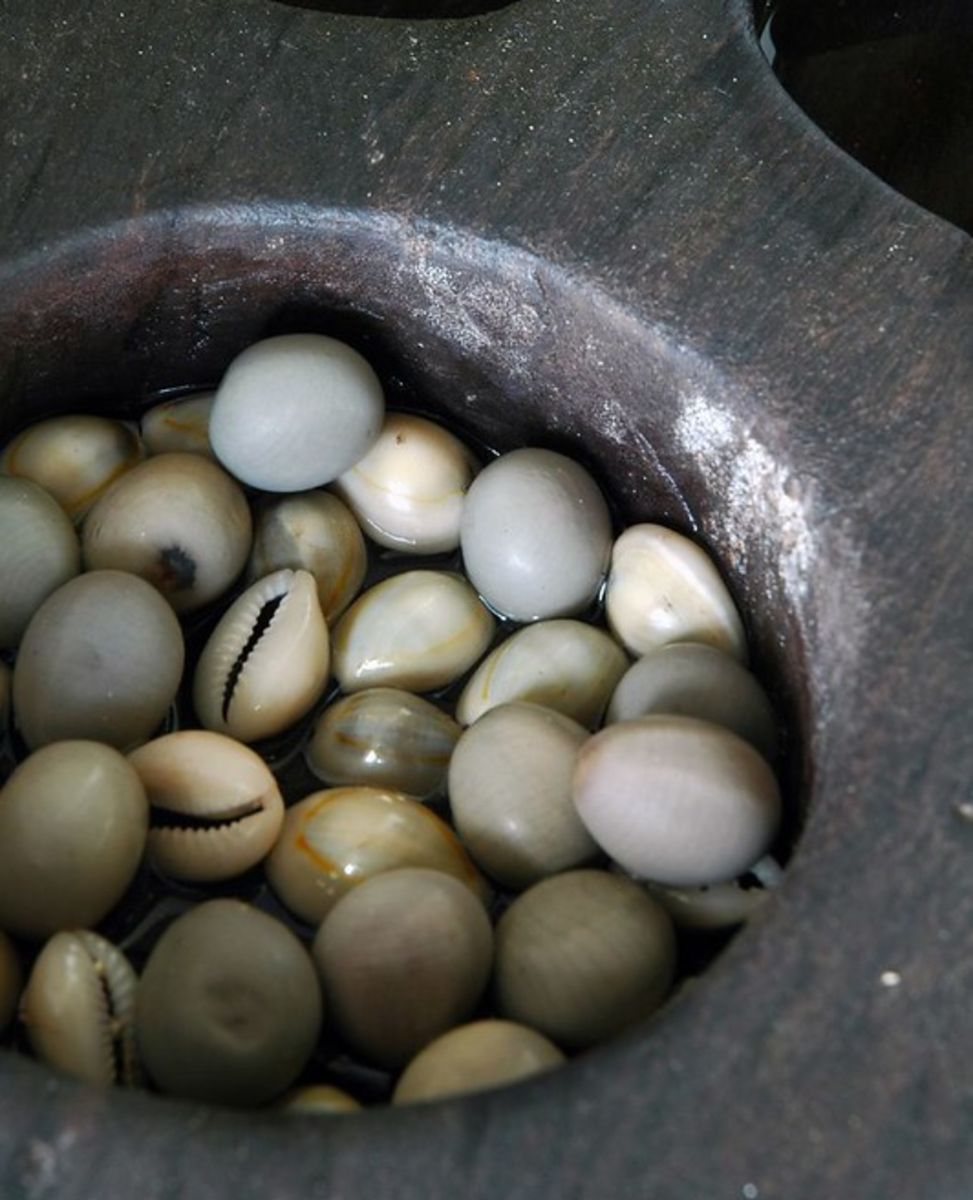
In the ancient days, mancala games, known by many names including opon ayo, awele, and oware, were played with small irregularly shaped stones in hollow holes dug out from the earth. The stones were placed in and moved around in a clockwise manner from one hole to the other. With time, the natives developed the art of carving wood or rocks to create playing boards while replacing the rough stones with large seeds, beans, cowries or seashells, depending on the geographical region of the players. Stone mancala boards have been found carved into the floors of temples in Memphis, Thebes, and Luxor.

Despite its age and primitive origins, the mancala game is a mathematical game of tactics that can be played with whatever medium happens to be around you. Some of its more complex versions have as wide a scope as that of a Chess game. The objective of the game is to accumulate more stones than an opponent, leaving him or her with no legal move and no choice but to concede.


Variations of Mancala Games


Opon Ayo

This is a traditional mancala game played by the Yoruba people of South-West Nigeria. It is composed of a wooden board with 2 rows of 6 holes each. 48 seeds are used, with 4 seeds placed in each hole. There are 2 players, and each player owns one row.

Oware

This genre of mancala is an abstract strategy game played worldwide with slight variations in the layout of the game. Though the origin of oware is not certain, it is believed to originate from the Ashanti people of Ghana.

Awari

This is another variant of the mancala game commonly played in Ivory Coast, on the west coast of Africa and is usually played by the elderly as a time-killer.

Awale

According to the Masai tribe of East Africa, awale was invented by the son of the first man, Maitoumbe, and was originally called geshe.

Awele

This is another member of the calculation game called Mancala. It is played by the Baule people, one of the largest tribes of Côte d'Ivoire (Ivory Coast). It, just like other variations, requires a carved wood board with 12 holes and 48 seeds. The board comes with two additional pits called score houses.


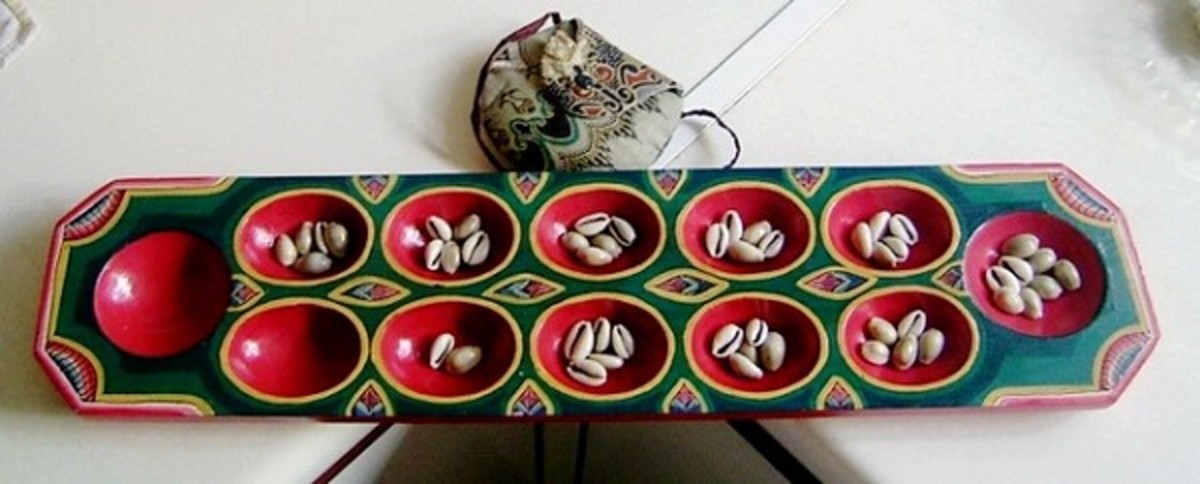
Beautiful mancala game board with cowrie shells as playing 'seeds'. Notice the delicate pouch that serves as storage for the cowrie shells.


There are hundreds of names attributed to the game, and this attests to the fact that there is an enormous range of the game and the people who play it. Other mancala board games are known as wale (Ivory Coast), Ambala (DRC), wari (Mali), Biri (Angola and Namibia), Bao la Kiswahili (East Africa), Hawale (Cameroon), and huri (Cape Verde). All these and many more are variations of the mancala game, but the principles behind each game remain the same: tactical, calculative, and strategic.

Generally, mancala game boards vary considerably in size, with the largest one, tchouba, with origins in Mozambique, and en gehé of Tanzanian origin. While Tchouba’s board consists of 160 holes and 320 seeds, the En Gehé is played on longer rows with up to 50 holes and 400 seeds. The smallest genres are the Nano-Wari and Micro-Wari. The nano-wari board has 8 seeds in just two pits, and the micro-wari has a total of 4 seeds in four pits.

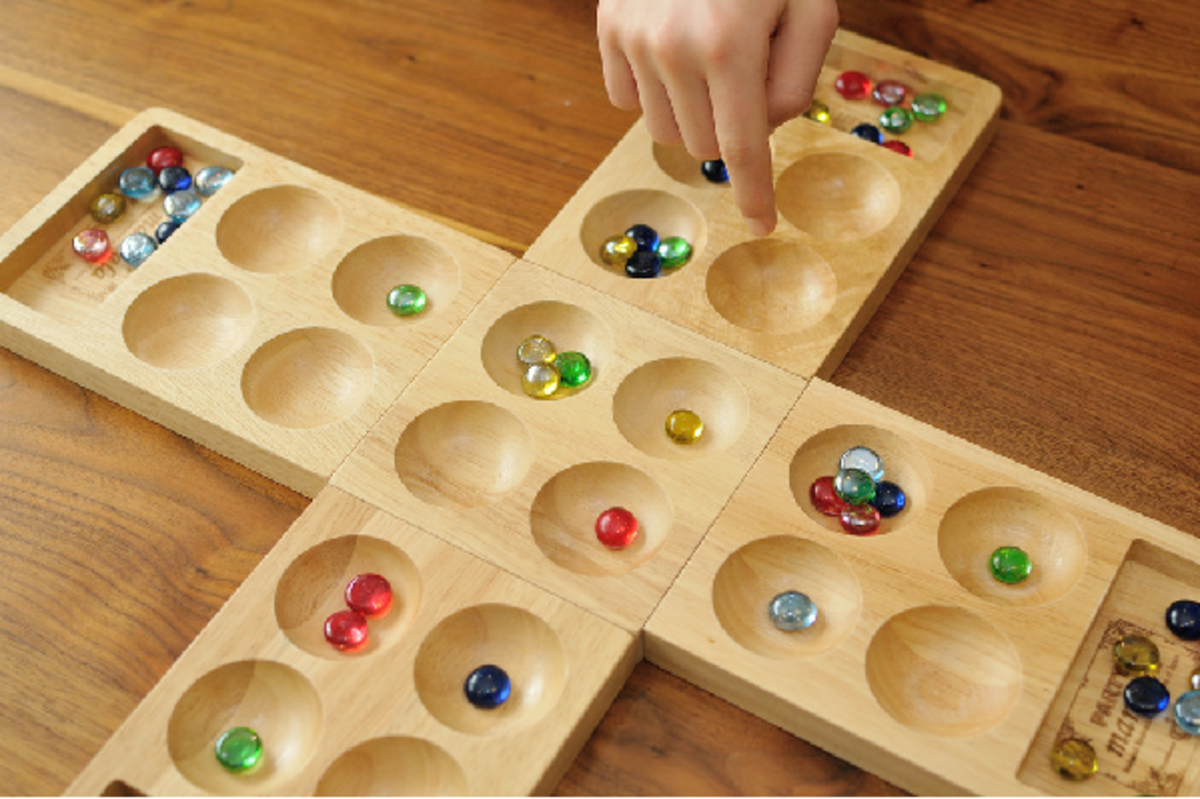
Some other variations of the game have more rows, and thus, more holes on either side of the board. This genre of mancala is known as the 4-rank mancala board game. The 4-rank variation is played by four people and is a modern type which has become quite popular with today's players.

Cowrie shells and seeds are used for the mancala gameplay. 

How to Play Mancala


Most Mancala games share a common gameplay where the players start by placing a certain number of seeds, prescribed for the particular game board, in each of the holes.

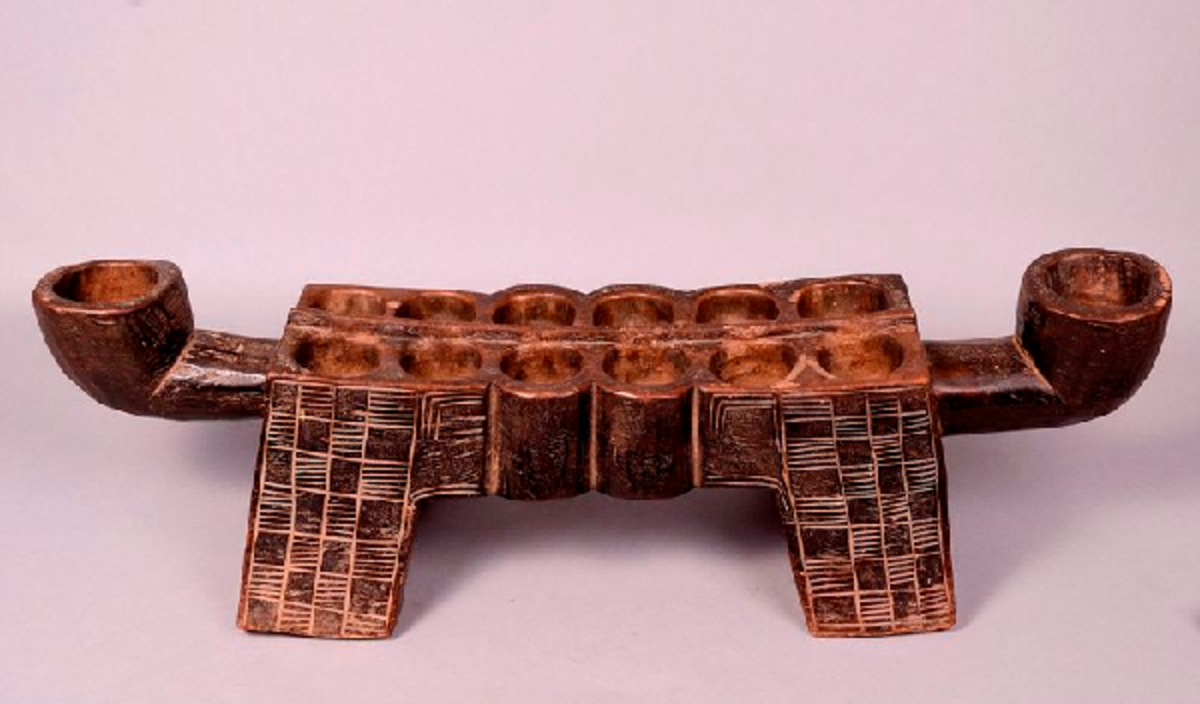
The mancala board is typically made of carved wood, but you will also find decorative board versions sculpted from natural stones like rock, granite or marble. While some boards are carved or sculpted with basic configurations, many are intricately designed with attached stands that depict animals that range from elephants, lions, and crocodiles. Some have figurine stands of carved figures holding up the game board.

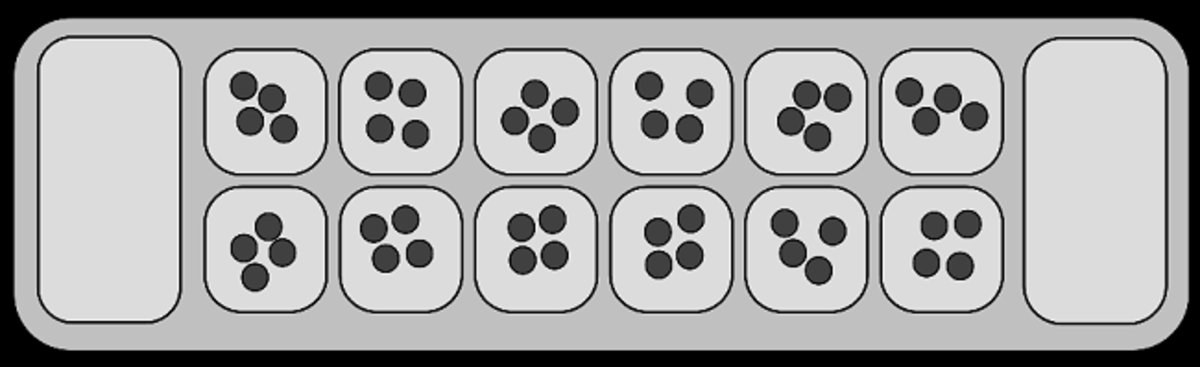
How a mancala game board is configured - Rows, holes, and seed store pits.


The board consists of 2 long rows (or ranks) with each player’s row comprising 6 holes (or pits). The board has a total of 12 holes. Some boards come with 2 store pits at each end of the board, one for each player to store their winnings (seeds).

To start the game, each of the 12 holes (24 in 4-player games) is filled with 4 seeds. The first player picks up the 4 seeds from any of the holes in his/her row and distributes them in a clockwise manner, dropping one seed at a time and in sequence into holes around the board. In the next turn, the other player follows the same pattern on his/her row of holes. This means that a turn consists of removing all seeds from a pit and placing one in each of the following pits in order.

How an opponent captures seeds is based on the state of the board and the number of seeds (2 or 4) gathered in holes of an opponent’s row. This leads to “count and capture", a phrase used to describe the play. This general sequence applies to all Mancala games. To capture more seeds than an opponent, each move must be tactical, and the player who gathers the most seeds at the end of the game is the winner.

There are a few simple rules: 
  • The hole a player can drop a bead into.
  • The process of collecting winnings.
  • When a player's turn is over.
  • Counting seeds to plot a game move.
To win the game, players must strive to accumulate the most seeds in their store pits.

Traditional and Modern Mancala Games


You can still find mancala boards that are old inheritances in some African and Asian homes. As they age over time, they have become smooth and worn through many years of use. They are mostly passed down from one generation to another and are great relics of the past. Plymouth City Museum and Art Gallery have what is probably one of the best mancala boards in any British museum (made by the Yoruba and Benin people of Nigeria) in its collections.


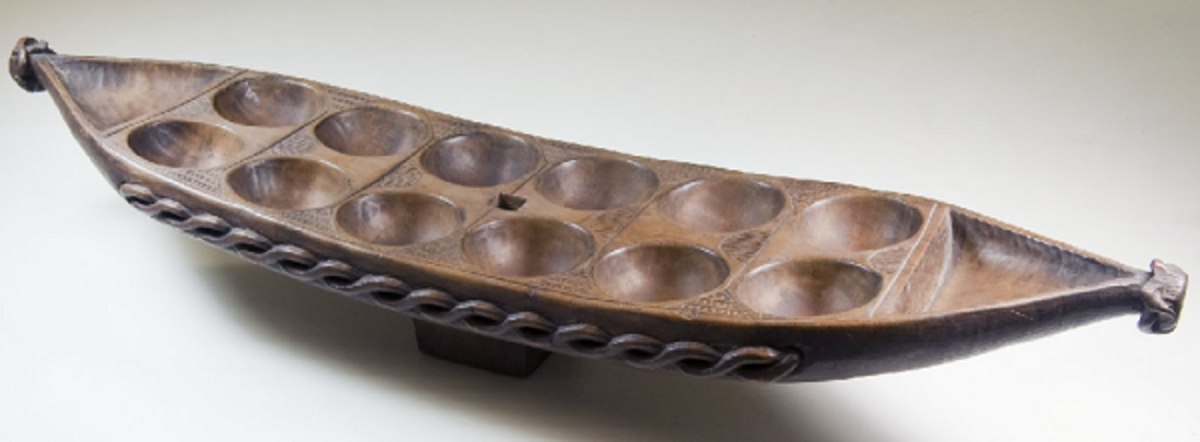
Traditional wood-carved mancala game with 2 rows of 6 holes each, and two seed store pits.


Modern 4-rank mancala board game made from engineered wood. A 4-player genre of the game.

Modern mancala board games are made from different kinds of materials that range from engineered wood and leather to acrylic, copper, bronze, marble, and tempered glass. They come in different shapes, forms, sizes, textures, and colours and can be open-cased or open-close hinged boxed mancala games.

(Article originally published by the author at Hubpages.com on 10/18/09)

Related articles
Smart Kids Are Making Money Online Testing New Video Games

Kidpreneurs: How Young Kids Can Earn Money as a Side Hustle

Do you know that kids can earn money online too? Earning money on the internet has become so widespread that within another decade, almost everyone will have the ability to make extra money (or even an income). And some smart kids have joined the earn-money-online train by learning entrepreneurship at a young age.

While some online opportunities are not age-specific, you will find that there are many online money-making ventures that kids can’t venture into until they are sixteen. But the good news is that there are jobs you can do in your spare time, even if you are not yet sixteen.


If you are under sixteen, you can earn money in a number of ways, but first, you'll need an adult's consent and, in some cases, expect some form of parental supervision. If you are over sixteen, there are more online jobs you can do. Some may require minimal supervision, but with most, you can go it alone.

You must be prepared to work extra hard for extra money, but you must also approach it more as a hobby or something you absolutely enjoy doing. There is a lot of hard work that goes into earning money either online or offline, and it doesn't matter if you are a kid or an adult; you'll have to start off being inspired. Then make sure you are patient and work persistently at whatever you choose to do.

Kids will need online supervision.

To Parents: Kids Online Need Supervision


Allowing kids under sixteen to earn money online is a great idea, but it requires adult supervision. They must be overseen and monitored. The internet is a global community, and just as in any community, you wouldn't let your kid wander around aimlessly in the community without guidance.

You should check periodically to make sure they are not using any illegal means to make money on the internet. They should also be observed to guard against them getting obsessed with making money online and thus neglecting their studies.

Earning extra cash by themselves will serve as a foundation for a future where they will have acquired the ability to handle financial challenges on their own.

Ways to Earn Money Online if You Are a Kid


If you are under sixteen, before you decide to earn money online (or offline), you must understand that you can only work in your spare time. An online job must not affect your schoolwork in any way. Secondly, you must get adult consent, and this is equally important.

And if you are a parent and you’ll like your kid to learn some money-making skills or simply learn how to make some pocket money, here are some ideas to consider:
  • Selling T-shirts
  • Selling candy
  • Writing (freelance)
  • Taking paid surveys
  • Tutoring
  • Selling on eBay

1. Selling T-Shirts Online


Whether you are creative or not, you can do this and earn good money online and even offline too. Designing and selling t-shirts online for money is not so hard, but you will need to learn how to use T-shirt design software. Sounds difficult? Not really.

Kids who earn money online can earn it in two ways. Sell your designs by uploading them to a marketplace like SpreadShirt (it's free). Creating your designs is not hard and can be anything from cartoon-like characters to doodles or any other simple type of sketch.

You can learn to use simple software like Microsoft Paint to create your designs and have them printed on t-shirts you can sell online or offline. Your parent or an older sibling can help you out with transactions and how to get the money you've earned.

If you are over sixteen years, you can open your own free T-Shirt store online and sell not only tees but caps, hoodies, mugs, phone cases, sportswear, sweatshirts and more. People who buy from you will come from all corners of the world, from New Jersey to New Zealand. When they buy from your online store, it's at the click of a button.

Additionally, creating an online store means you can sell your products to other kids at school or the people in your neighbourhood.

2. Selling Candy


This may appear like an offline job for kids, but it involves some online buying too.

For as little as a $15 investment, you can make money by selling candy at school. This is a good example of "physical" selling offline. With your little investment, which you can loan from your parent or relative, you can buy a large variety of packs of candy (or other edibles) online from major wholesalers like Costco or Sam's Club (Macey's costs a bit more).

You buy wholesale and sell the individual pieces at regular market prices, less a few cents if you wish. A kid can earn money by doing this every school day, five days a week.

You can also sell games and cards to your schoolmates because many kids love games and cards and will willingly buy from you. There are game companies that will offer their affiliates a free store to sell their products. Amazon and eBay are two large companies that allow you to sell their products. You must be eighteen to be able to join Amazon or eBay, so again, you'll need the help of an adult to set up an account on your behalf.

3. Writing (Freelance)


You can earn money online by writing for other people. This is called freelance writing.

There are many freelancing services out there, and depending on your reading and writing skills (and what you've been asked to write about), you may be qualified enough to write for people online or even offline.

Some kids who are 7th-grade level and above can write and get their messages across. Complex writing may not be necessary as long as there are no typing errors, the grammar is fine, and you get the points across, which is primarily the main goal.

Some students need to write out their essays or do a report on a school project, and they may need your help. It shouldn't be for free. You can use your expertise as a good writer to create reports on a subject you are passionate about and sell them online for a small profit. The reports need not be more than 7 to 20 pages long and should only contain content that young people or other kids can use.

4. Taking Paid Surveys


You can make money online by filling out paid surveys. It is one of the easiest online jobs to do, and you need zero experience to do it. If you do surveys consistently, you will always earn a bit of pocket money on the side.

Both the young and adults fill out paid surveys every day, and this is a legitimate opportunity for you to make at least $2 an hour, depending on what goals you wish to achieve. With some online survey sites, you also earn free stuff for your opinion about their products, and it can involve anything from games and gift cards to packs of edibles. It's very easy to do a few surveys each day, and it takes roughly a quarter of an hour to complete one.

Know which websites to use and how to use them, and if you need guidance on how to succeed in paid surveys, you may want to try reading a guide on how to take paid surveys to make extra cash.

5. Tutoring


Yes, it's true. You can earn pocket money teaching or writing essays for other kids online or offline. Today's younger generation is more computer savvy and technologically smarter than their parents and grandparents. So, when it comes to using computers, notebooks, and smartphones, being on the internet is like being in a second home.

The older kids can actually tutor other kids. Some are known to offer tutorials to the older generation, teaching them how to use the internet, apps, and any operating system.

Making money by offering tutorials online may require that you source initial financing to buy a good-quality headset and webcam. Here is where your parents or relatives can help you start your tutoring business online. You can always pay them back from your earnings.

If you want to spread the word about your work, make some flyers and distribute them in your locality. Your grandparents or elderly relatives can also help advertise your skills among their friends and acquaintances. They will certainly love to do you that favour.

6. Selling on eBay


Who said online selling was only for adults? If you are over eighteen, you can sell on eBay.

Though eBay doesn't allow minors to set up an account, your parents can create an account for you. Once the account is set up, you can start to create items such as handmade crafts, artwork, t-shirts with your designs, caps, mugs, and simple stuff like this. There are always some people out there, anywhere in the world, who will like your products, and some will buy.

If you make crafts like rag dolls, beaded bracelets, paintings, or pottery, you can sell them on eBay. Discuss your creative abilities with an adult and ask them to show you how to translate them into cash.

You can also sell your used or unused school supplies that you no longer need on eBay. Or you can sell toys and stuffed animals you've outgrown, as long as they are in great condition.

If you have gifts you got at Christmas, for instance, sell them on eBay too. Basically, presents, supplies, and unwanted items are some of the things that can be sold online. You can also sell items you find at garage sales, boot sales, garden sales, thrift stores, or any other items you can get at giveaway prices.

Kids Can Earn Money Online with Encouragement and Guidance


Starting early to learn entrepreneurial skills has its advantages. Working for a couple of hours each day means spending less time watching television, playing video games, or generally being idle. The feeling of earning money for themselves will boost their confidence even further and help them learn to become future entrepreneurs.


Who knows, a kid who is inspired to do these things may become the next young millionaire. It does happen. Parents or mentors can further check online websites or books that write about ways for kids to make money online and discuss the possibilities with them.


(Article originally published by the author at hubpages.com on 06/22/09)

Articles of interest

Slow-Living Hacks: Self-Care, Mindful Spaces, and Personal Development

Today, slow-living is more than a trendy concept. It is a mindset shift that helps us reconnect with what truly matters in life.

Rooted in mindfulness, intentionality, and simplicity, slow living is about creating space for peaceful stillness and growth.

From our daily routine to inner reflections and how we style our homes, this post will tell you how to find actionable slow-living hacks that can bring peace, balance, and purpose to our lives.

Peace and tranquillity.


The Fundamental Ideas that Guide a Slow Living Lifestyle


The three key aspects of the slow-living movement are:
  1. Presence and mindfulness. Being present in the moment.
  2. Essentialism. Focusing on what truly matters and eliminating excessive and impulsive actions.
  3. Connection with people and our natural surroundings.

These three all work together and are interconnected to create a more balanced, intentional, and fulfilling way of life. Here you will find actionable slow-living hacks to help you cultivate peace, balance, and purpose.


Wellness: Self-Care Routine and Mindfulness Practices


At the heart of the slow-living lifestyle is mindfulness, a practice of being fully present and aware of the moment without judgment. When you combine mindfulness with intentional self-care, you create a powerful tool that reduces stress and enhances overall wellness.

Morning Rituals for a Mindful Start

Ideas for intentional self-care and mindful morning routine:
  • Start your day without your phone.
  • Do not check your emails or social media notifications.
  • Do 5 minutes of deep breathing exercises, or if you can, meditate. This helps set a calm tone and keeps you from immediately slipping into reactive mode.
  • Drink a warm glass of lemon water.
  • Stretch or practice gentle yoga.
  • Read a page from an affirmation book.

Build a Mindful Evening Wind-Down

Create a digital sunset. Build boundaries between digital activity and personal time by intentionally disconnecting from all electronic devices.
  • At the same time, preferably an hour before bedtime, switch off your phones, laptops, TV, and other devices.
  • Focus on activities that ease your nervous system. These include journaling, reading, drinking some herbal tea, or having a relaxing bath.
  • Use essential oils like lavender or chamomile in a diffuser. This tells your body that it's time to wind down.
These practices help to improve sleep quality, reduce stress, and create a healthier work-life balance.


Home: Organise Your Home for a Calmer Mind.


Our physical environment reflects our mental state. For those living in apartments or compact homes, intentional organisation becomes even more crucial. Clutter leads to mental overwhelm. When you simplify your living environment, your home feels spacious and organised and promotes clarity and peace.

Declutter with Purpose

  • Follow the “One In, One Out” rule, which states that for every new item brought into your home, you remove a similar item. This helps to maintain a consistent level of belongings and prevent clutter from accumulating.
  • For every new item you bring into your home, donate or sell an existing one. This prevents buildup and encourages mindful consumption.

Small Space Organisation

  • Use vertical storage like floating shelves, wall hooks, etc.
  • Choose multi-functional furniture, like ottomans with built-in storage space.
  • Rotate seasonal items to keep closets light and fresh.

Design for Calm and Clarity

  • Creating zones within interior spaces by designating areas for work, rest, and play can bring structure and calm.
  • Use rugs, lighting, or shelving to define these zones.
  • Keep surfaces clear, and use natural elements like wood, linen, plants, and soft lighting to create a cosy atmosphere.

Personal Growth: Journal Prompts for Personal Growth


Slow living isn’t just about your environment. It is also deeply rooted in inner transformation. This is where journal prompts for self-discovery come into play.

Journaling is a powerful, accessible tool for self-discovery, emotional regulation, and goal-setting. It allows you to reconnect with yourself beyond the noise of the external world.
  • Make journaling your daily routine. Practice it consistently and diligently.
  • Combine it with an existing habit, pairing it with your morning coffee or evening tea.
  • Just five minutes a day of writing in your journal will give you profound results.

Journal Prompts for Slow Living & Self-Discovery

Use the following prompts as examples to guide your inner work and mindfulness practice:

* What does slow living mean to me personally?

* Where in my life do I feel rushed or out of alignment?

* What activities make me feel truly present?

* What am I holding onto that no longer serves me?

* How can I create more space for rest and reflection?

These prompts help you notice patterns, release mental clutter, and realign with your values.


Bonus Hacks for Embracing the Slow-Living Lifestyle


Here are a few more slow-living hacks to integrate throughout your day:
  1. Single-task instead of multitasking
  2. Focus on one thing at a time—whether it’s sipping tea, writing an email, or folding laundry.
  3. Digital detox. Dedicate tech-free windows throughout the day to reconnect with nature, people, or silence.
  4. Eat slowly and mindfully. Appreciate tastes, flavours, and food textures without distractions. This also aids digestion and reduces stress.
  5. Practice gratitude. Write down three things you're thankful for each day to cultivate presence and positivity.

Why Slow Living Is Worth It


Slow living is not about doing less just for the sake of it. It’s about doing what matters *more intentionally*. It’s creating a lifestyle where your mind, body, and environment are in harmony. It is simple living.

Whether it’s refining your self-care routine, turning your small space into a peaceful sanctuary, or going deep into journaling and inner work, slow living allows you to breathe, reflect, and live fully with intention.

Take these slow-living hacks and make them your own. Start small. Be consistent. And remember: the pace of your life should reflect the pace of your soul.


This Is What We Have to Do When We Start to Age
Health, Wellness, and Financial Well-Being at Sixty-Plus
What Are Longevity Supplements and How Do They Work?
Effects of Fresh Flowers on Senior Citizens